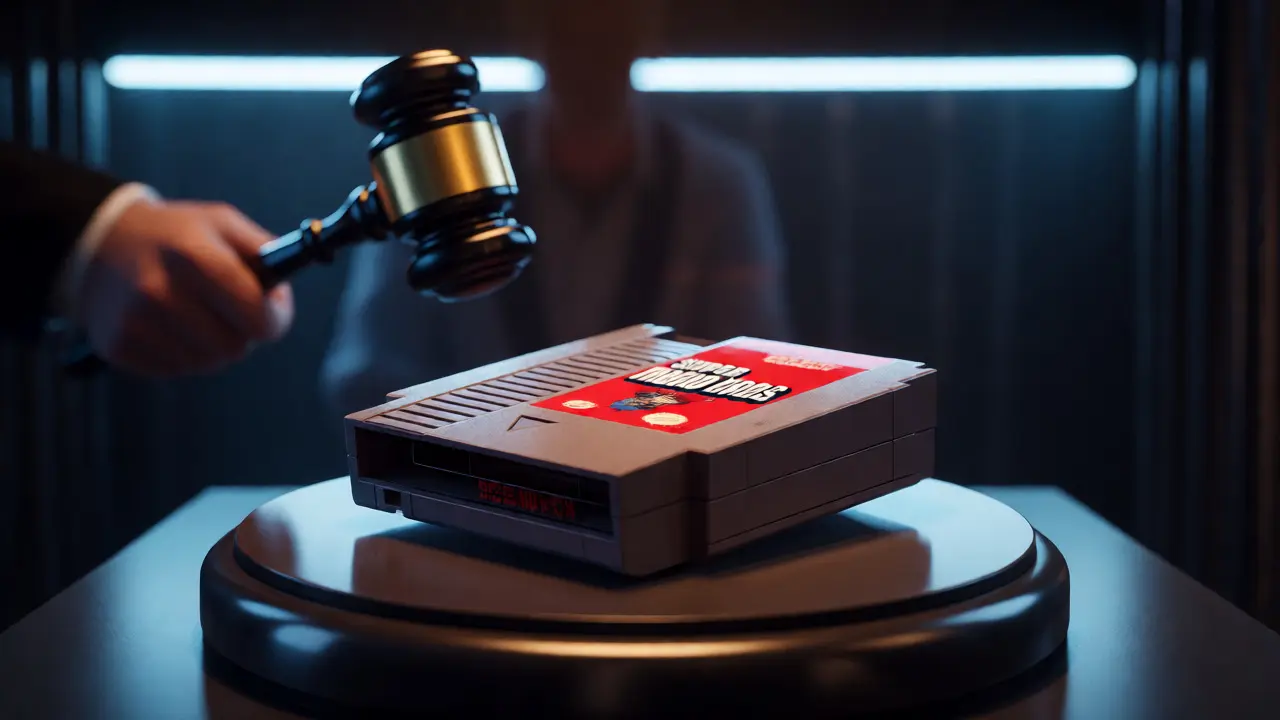
You just watched the final bid drop on a sealed copy of Super Mario Bros. for Nintendo Entertainment System. The screen flashes "SOLD" at $1,200. You feel that rush of victory, but then your bank account notification hits you with a different number: $1,458. What happened? Did the auction house make a mistake? Or did you miss a crucial detail in the fine print?
This is the most common shock for new collectors entering the world of video game auctions. The difference between what you see on the screen and what you actually pay comes down to two specific terms: Hammer Price and Buyer’s Premium. Understanding these isn't just about accounting; it's about knowing your true cost ceiling before you raise your paddle (or click) even once.
The Core Difference: What You Bid vs. What You Pay
Let's strip away the jargon. The Hammer Price is simply the winning bid amount. It is the highest offer accepted by the auctioneer when they slam their gavel (or end the online timer). This number belongs to the seller. If you won a rare EarthBound cartridge for $500, the seller gets $500 minus their own commission fees.
The Buyer’s Premium is an extra fee charged by the auction house to cover their operational costs. Think of it as a service charge for facilitating the sale, verifying authenticity, and handling logistics. This fee is added on top of the hammer price. So, if you bid $500 and there is a 20% buyer's premium, you owe $500 + $100 = $600 total.
Why does this matter? Because many beginners calculate their budget based only on the hammer price. They set a mental limit of $1,000 for a game, win it at $950, and then panic when the final invoice shows $1,140. Always assume the final price will be higher than your last bid.
Calculating the True Cost: A Step-by-Step Guide
Most major auction houses use a tiered structure for their premiums. It’s not always a flat percentage. Here is how you can do the math quickly while bidding live or planning offline.
- Identify the Premium Rate: Check the Terms and Conditions (T&C) of the specific auction house. Common rates range from 15% to 25%. Some platforms like Heritage Auctions might have different tiers for different price brackets.
- Apply the Percentage: Multiply the Hammer Price by the premium rate. For example, $1,000 x 0.20 = $200.
- Add Sales Tax: Depending on your location (like Oregon, where we don’t have sales tax, versus California, where you might), you may need to add local taxes to the total amount (Hammer + Premium).
- Check for Hidden Fees: Look for shipping, insurance, or payment processing fees. PayPal and credit card processors often add another 3-4% on top of everything.
| Component | Amount | Note |
|---|---|---|
| Hammer Price (Winning Bid) | $1,000.00 | What you saw on screen |
| Buyer’s Premium (20%) | $200.00 | Auction house fee |
| Subtotal | $1,200.00 | Pre-tax total |
| Sales Tax (Assume 8%) | $96.00 | Varies by state/location |
| Payment Processing (3%) | $38.88 | Credit card/PayPal fee |
| Total Out-of-Pocket | $1,334.88 | Your actual cost |
Notice how a $1,000 bid turns into nearly $1,335. That is a 33% increase. If you didn't factor this in, you effectively overspent by over $300 without realizing it until the bill arrived.
Why Auction Houses Charge These Fees
You might wonder why the buyer pays so much when the seller also pays a commission. It comes down to risk and verification. In the video game market, authenticity is everything. Is that Pokemon Gold cart genuine? Has the label been reprinted? Has the PCB been swapped?
Auction houses employ experts to grade, verify, and sometimes encapsulate games (like Wata Games or VGA grading). The buyer's premium funds this expertise. When you buy from a reputable house, you are paying for the guarantee that the item matches its description. If you buy from a private seller on eBay, you take on all the risk of fakes, but you usually avoid the high buyer's premium.
Additionally, these fees cover the platform's technology, marketing, and customer support. Running a global auction site for niche items like sealed Atari 2600 boxes requires significant infrastructure. The premium ensures the lights stay on and the bidders get a smooth experience.
Strategic Bidding: How to Factor Premiums Into Your Max Bid
Don't let the premium surprise you. Work backward from your maximum willingness to pay. Let's say you value a specific Chrono Trigger SNES game at $300 total. You want to spend no more than $300 out of pocket.
If the buyer's premium is 20%, your max hammer price should be lower. Use this formula:
Max Hammer Price = Desired Total / (1 + Premium %)
$300 / 1.20 = $250.
This means you should stop bidding once the hammer price hits $250. Any bid above that will push your total cost over $300 once the premium is added. Many bidders fail here because they focus on the round numbers ($250, $300, $350) rather than the mathematical break-even point.
Also, consider the Reserve Price. Sometimes, the seller sets a minimum price below which the item won't sell. If the bidding stalls at $100 but the reserve is $150, the item remains unsold. Knowing the typical hammer prices for similar items helps you gauge if a reserve is realistic.
Common Pitfalls in Video Game Auctions
Even experienced collectors slip up. Here are the traps to watch for:
- Ignoring Tiered Premiums: Some auction houses charge 25% on the first $500 and 20% on anything above. If you bid $1,000, you aren't just paying 20% on the whole thing. Read the fine print!
- Forgetting Shipping Costs: Sealed games are heavy and fragile. Insurance and specialized packaging can add $20-$50 to the bill. This isn't part of the premium, but it adds to your total cost.
- Assuming All Platforms Are Equal: eBay has different fee structures than Heritage Auctions or Sotheby's. eBay might charge a final value fee to the seller, but buyers rarely pay a large premium unless using specific authenticated services. Compare the total cost across platforms.
- Bidding War Emotion: When two people fight for a rare Legend of Zelda prototype, logic goes out the window. Set your hard cap before the auction starts. Do not adjust it mid-bid unless new information emerges (like a better grade report).
Where to Find Reliable Data
To interpret hammer prices correctly, you need context. A $500 hammer price for a loose Mega Man X might be a steal or a rip-off depending on condition. Use databases like PriceCharting or completed listings on eBay to establish baselines.
When looking at past auction results, always look for the "Sold" status, not just the current bids. And remember, historical hammer prices do not include the current year's premium changes. If a game sold for $200 last year, and premiums increased from 15% to 20% this year, your entry cost has risen even if the hammer price stays flat.
By mastering the relationship between hammer price and buyer's premium, you transform from a reactive bidder to a strategic collector. You stop chasing ghosts and start making informed investments. The next time you see a "SOLD" sign, you'll know exactly what it cost-not just what it looked like it cost.
Is the buyer's premium refundable if I return the item?
Generally, no. Most auction houses consider the buyer's premium a non-refundable service fee for facilitating the transaction. However, if the item was significantly misrepresented (e.g., fake or damaged beyond description), some houses may refund the premium along with the hammer price. Always check the specific return policy before bidding.
Do all auction houses charge the same buyer's premium?
No, rates vary significantly. Major houses like Heritage Auctions or Christie's may charge between 15% and 25%, while smaller niche sites might charge less or have different tiered structures. Online-only platforms may have lower premiums due to reduced overhead. Always check the specific T&Cs of the auction house hosting the sale.
Does sales tax apply to the buyer's premium?
It depends on your jurisdiction. In many US states, sales tax applies to the total transaction amount, including the buyer's premium. In others, tax might only apply to the tangible goods (the game itself). Since laws change frequently, consult a local tax professional or check the auction house's checkout page for accurate calculations.
Can I negotiate the buyer's premium?
Rarely. The buyer's premium is a fixed policy set by the auction house to cover their costs. While you can sometimes negotiate the hammer price privately before an auction (known as a pre-sale negotiation), the premium itself is almost never negotiable for standard lots.
What happens if I win but cannot pay?
You will likely face penalties. These can include losing your deposit, being banned from future auctions, or having the item resold at your expense if it sells for less than your bid. In serious cases, auction houses may pursue legal action for the unpaid balance plus fees.