Why Original Arcade PCBs Are Worth More Than You Think
Not all arcade games are created equal. If you’ve ever seen a Neo Geo MVS cartridge up close-black case, chunky size, that unmistakable SNK logo-you know it’s not just another game card. It’s a piece of hardware built for arcades, not living rooms. And because of that, original PCBs (Printed Circuit Boards) from the late 80s and 90s are some of the most sought-after items in retro gaming. But here’s the truth: most people buying these online have no idea what they’re actually getting. Bootlegs are everywhere. And if you don’t know how to spot them, you could pay $800 for a $50 fake.
How to Tell Real from Fake
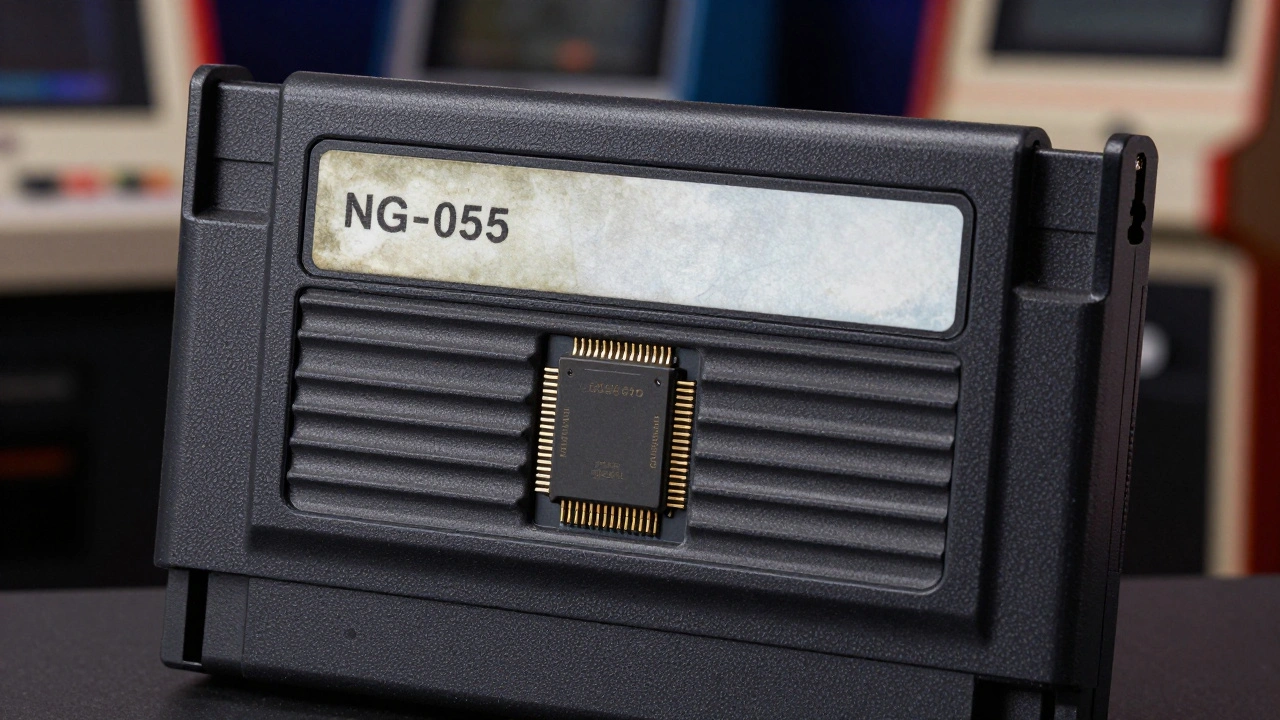
Authentic Neo Geo MVS cartridges have three things you can’t fake: the chips, the case, and the label. First, look at the PCB itself. Real boards use SNK-specific chips with NG numbers printed directly on them. NG 030? That’s Super Baseball 2020. NG 055? King of Fighters ’94. These numbers aren’t random-they’re the serial keys to authenticity. The Neo Geo MVS Scans website is the go-to database for this. It has high-res photos of every known authentic board. If a seller won’t show you clear pictures of the chips, walk away.
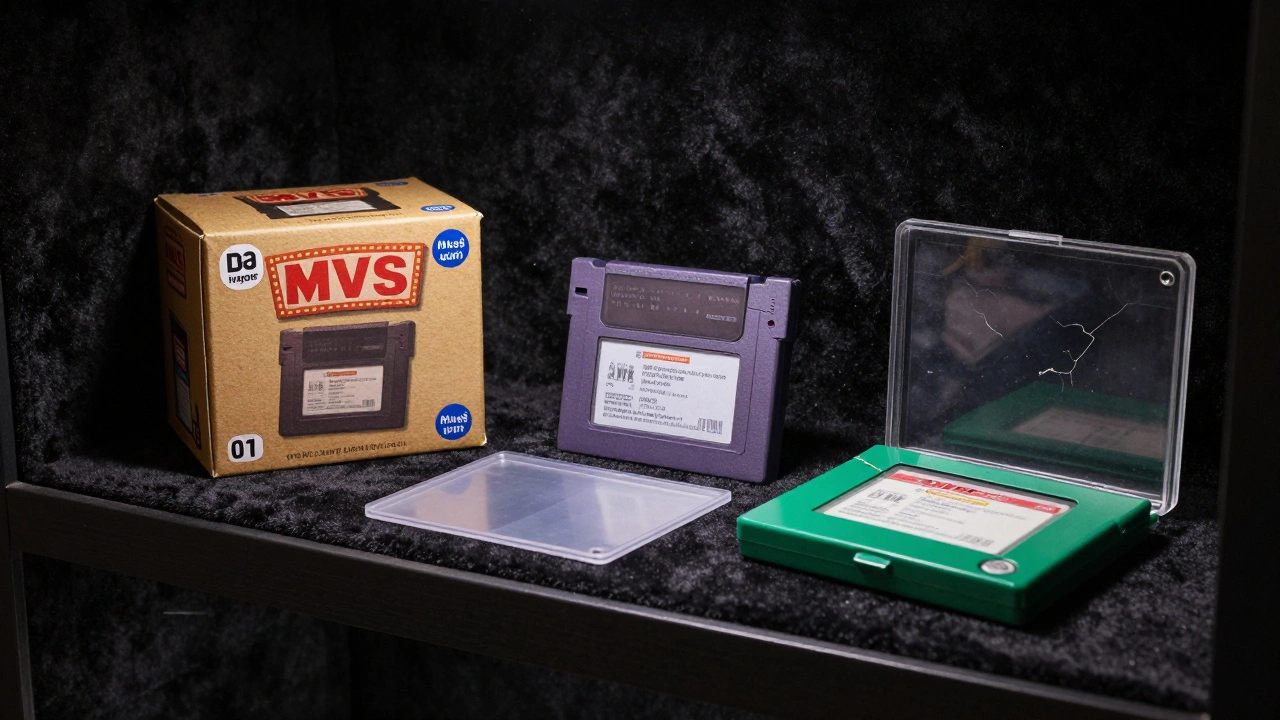
Now check the case. Real MVS cartridges come in full-size, opaque black plastic. Bootlegs? They’re often half-size, shoved into clear green cases. That’s a dead giveaway. Why? Because fake makers use cheaper, smaller PCBs to save on materials. And if you see a mix of UV-erasable and MX chips on the same board? That’s another red flag. Real boards never mix those.
Labels matter too. A pristine label doesn’t mean it’s real. Many bootlegs have perfect-looking labels. But real labels have faded ink, slight curling, and most importantly-they match the NG number on the PCB. Look for a four-digit code printed on both the label and the board. If they don’t line up, it’s not authentic. Check eBay sold listings. See how real labels look after 30 years of use. That’s your benchmark.
Loose Cartridges vs. Kits: The Price Gap
There are two ways to collect MVS: loose and kit. Loose means just the PCB. No box. No marquee. No manual. These go for $50-$300 depending on the game. Gun Run? Maybe $600 if it’s real. But if you want the full experience-the original cardboard box, the matching serial sticker, the mini marquee, even the plastic insert-you’re looking at $799 to over $1,500. Kits are rare. And they’re valuable because they’re complete. Most collectors who spend big go for kits. They’re the only way to preserve the original packaging that SNK designed to sell these in arcades.
There’s also a hidden split: MVS cartridges vs. standalone PCBs. King of Fighters 2003, for example, was sold in Japan as a standalone PCB for about half the price of the MVS version. Why? Because it was meant for arcade owners who already had cabinets. If you have an arcade cabinet, you can save hundreds by buying the standalone board. But if you’re collecting for display or resale? Stick with the MVS cartridge. It’s the format collectors want.
Where to Buy (and What to Avoid)
eBay is the easiest place to find MVS cartridges-but also the most dangerous. You’ll see listings with titles like "Rare Neo Geo MVS - Working!" and no photos of the PCB. Don’t buy it. Instead, look for sellers who include clear, close-up shots of the chips. Cross-reference them with Neo Geo MVS Scans. If it matches, you’re probably safe.
For better deals and more authentic stock, try Yahoo Auctions through Buyee or Jauce. Japanese sellers often have older stock still in original condition. The Neo Store is another trusted source-they authenticate every board before shipping. And don’t ignore Facebook groups. The Neo Geo Collectors group has over 12,000 members. People trade, verify, and warn each other about known bootlegs. It’s the best community resource you’ll find.
Avoid sellers who say "I don’t have photos because the board is in a cabinet" or "It works fine, so it must be real." That’s not how this works. Functionality doesn’t prove authenticity. A bootleg can play perfectly. You need proof it’s the real thing.
Repairs: What You Might Be Getting Into
Even real MVS boards get damaged. Heat, age, moisture-they all take a toll. The most common issue? Corroded traces on the PCB. You’ll see green or white crust around the edge connectors. That’s oxidation. It breaks the connection between the board and the cabinet. Some collectors clean them with isopropyl alcohol and a soft brush. Others send them to specialists who reflow solder joints or replace damaged traces.
High-value games like Gun Run or Samurai Shodown II are especially prone to this. If you’re spending over $500, you need to ask: "Has the board been tested?" "Are there photos of the backside?" "Is there visible corrosion?" A board that looks clean on the front might be completely dead underneath. Don’t assume it works just because the seller says so. Ask for a video of it booting in a real cabinet.
Storage: Why Your Shoebox Won’t Cut It
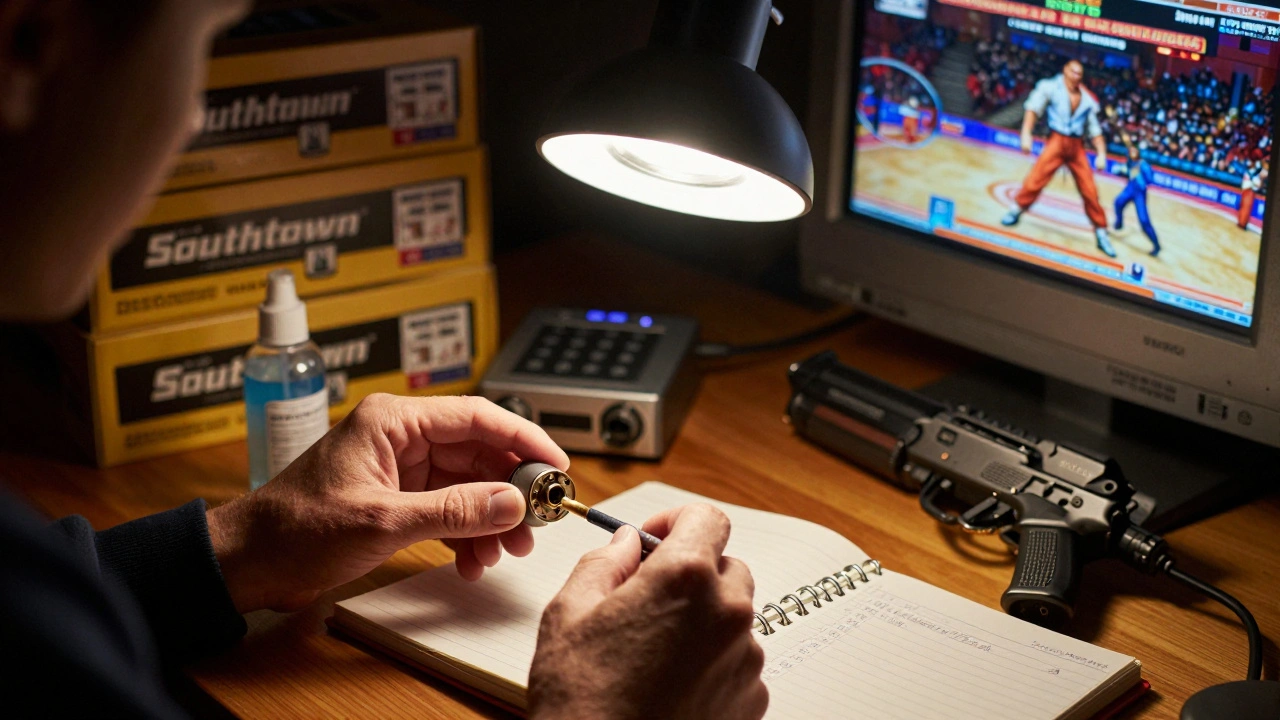
These cartridges are huge-bigger than most NES or SNES carts. Stacking them on a shelf? Bad idea. Dropping one? You might crack the PCB. That’s where Southtown Shockboxes come in. These are custom plastic boxes designed to hold MVS cartridges with foam inserts that absorb shock. They’re not cheap-around $40 each-but they’re the only thing that keeps your investment safe.
Some collectors use acrylic display cases with UV-filtering glass. That’s fine if you’re showing off your collection. But for long-term storage? Shockboxes win. They’re stackable, dustproof, and designed to handle the weight of 20+ cartridges. Forget plastic bins. They don’t protect the edge connectors. And don’t store them in basements or garages. Humidity kills PCBs faster than you think.
Playing MVS Without an Arcade Cabinet
You don’t need a full arcade cabinet to play these boards. That’s where Superguns come in. These are small devices that convert the JAMMA signal from an MVS board into a video output you can plug into a TV or monitor. The Parsec Supergun is the most popular. It supports 2-player input and works with CRTs or modern LCDs via HDMI converters.
Want to play 2-player games like Double Dragon? You can use a 2-player conversion kit to bypass the 4-player restriction on some boards. ROM swaps let you change character sets or even turn a single-game board into a multi-game one. But be careful-modifying the board can lower its value. Purists avoid it. But for players who just want to enjoy the games, it’s a practical fix.
Neo Geo AES vs. MVS: Don’t Confuse Them
Here’s a common mistake: people think AES home cartridges are the same as MVS arcade carts. They’re not. AES carts are smaller, have a different shape, and plug into a home console. But here’s the twist: the game data inside is identical. King of Fighters ’94 on AES? Same ROM as the MVS version. So if you’re collecting for gameplay, AES is cheaper and easier to find. But if you’re collecting for authenticity? Stick with MVS. The arcade version is the original. The AES is just a port.
Final Tips: What the Experts Say
Don’t rush. Wait for clear photos. Cross-check every NG number. Use KLOV and ukVac forums to verify boards. Keep a notebook of what you own and where you bought it. And always buy from someone who answers questions. If they’re vague, they’re hiding something.
There’s no magic tool to spot bootlegs. It’s all about patience, research, and knowing what to look for. And once you start seeing the real ones? You’ll never settle for less.
How can I verify if my Neo Geo MVS cartridge is authentic?
Take clear, well-lit photos of the PCB, focusing on the chips where the NG number is printed. Compare them to the database on Neo Geo MVS Scans. Check the case color (authentic ones are black), size (full-size, not half), and label alignment with the NG number. If the board uses MX chips mixed with UV-erasable ones, it’s likely a bootleg.
Are bootleg MVS cartridges playable?
Yes, many bootlegs play perfectly. Some even have better graphics or faster load times than the originals. But they’re not authentic. They use fake chips, cheaper materials, and often have inconsistent ROM data. They’re fine for casual play, but if you’re collecting for value or historical accuracy, avoid them.
What’s the difference between MVS cartridges and standalone PCBs?
MVS cartridges are the arcade cabinet version with a plastic case and edge connector designed to plug into multi-slot cabinets. Standalone PCBs are the same game, but without the case-they’re meant for single-cabinet setups. Standalone boards are cheaper, often half the price, but they’re less desirable for collectors because they lack the original packaging and form factor.
Can I use a modern TV to play MVS boards?
Yes, but you’ll need a Supergun device like the Parsec Supergun to convert the JAMMA signal to HDMI or VGA. CRT monitors give the most authentic look, but modern LCDs with good upscalers work fine. Avoid direct HDMI connections-the signal won’t work without a converter.
Is it worth buying a complete kit instead of a loose cartridge?
If you can afford it, yes. Kits include the original box, marquee, serial labels, and packaging. They’re rarer, hold their value better, and are the only way to preserve the arcade experience as it was meant to be seen. Loose cartridges are fine for beginners, but serious collectors prioritize kits.