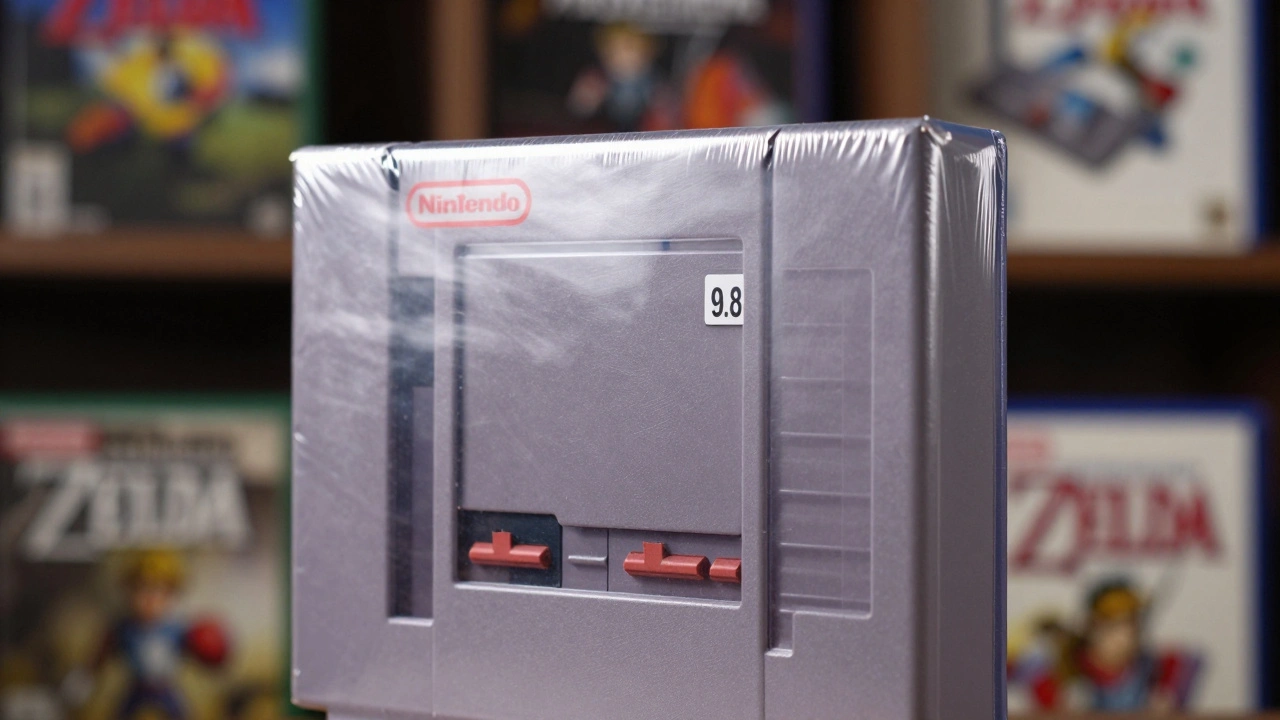
Imagine holding a copy of The Legend of Zelda for the Nintendo Entertainment System. In its raw, ungraded state, that box might sit on a shelf worth around $120. Now imagine that exact same game, sealed in plastic, submitted to a professional grading service, and emerging with a 9.8 grade. Suddenly, that same piece of plastic and cardboard is worth over $1.5 million. That isn’t just inflation; it’s a mathematical explosion driven by scarcity, psychology, and the rigid mechanics of third-party authentication.
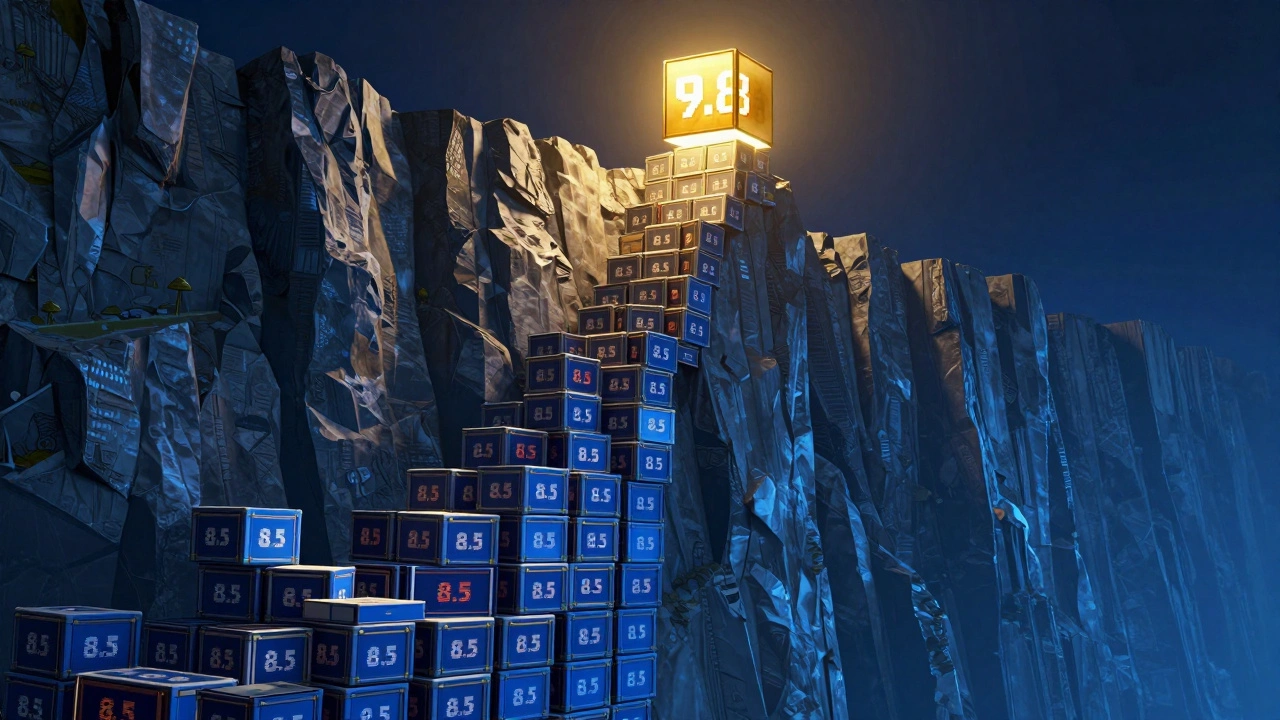
This phenomenon-the exponential price jump between grades like 8.5 and 9.8-is the defining characteristic of the modern graded video game market. It’s not a linear climb where every tenth of a point adds a fixed dollar amount. Instead, it’s a series of steep cliffs. Crossing from an 8.5 to a 9.0 might double your money. Jumping from a 9.4 to a 9.8? You’re looking at multipliers that defy traditional logic. For collectors and investors in 2026, understanding these breakpoints is the difference between a fun hobby and a catastrophic financial loss-or a life-changing windfall.
The Mechanics of the Grade Cliff
To understand why prices spike so violently, you have to look at how grading companies operate. The two dominant players are WATA Games and CGC Video Games. They don’t just look at a game; they dissect it. They assign a numerical score for the case (the box) and a separate letter seal for the shrink wrap (the plastic).
The scale runs from 1.0 to 10.0, but the real action happens above 8.0. An 8.5 grade means the game is "Very Fine+"-it has minor wear, maybe a slight corner bend or a small sticker residue. It’s still excellent, but it’s human. It was handled. A 9.8 grade, however, is "Mint." It implies the game was never opened, never touched by human hands after manufacture, and stored in perfect conditions for decades. The jump from 8.5 to 9.8 isn’t just about condition; it’s about probability. Statistically, finding a 9.8 is exponentially harder than finding an 8.5.
Let’s break down the tiers:
- 8.0 to 8.5: Moderate increase. You might see a 2x to 3x multiplier here. This is the entry point for serious collecting.
- 8.5 to 9.0: The first major cliff. Prices often triple or quadruple. This is where "very nice" becomes "near perfect."
- 9.0 to 9.4: The high-end threshold. Here, prices can jump 5x or more. A 9.4 is considered investment-grade for most iconic titles.
- 9.4 to 9.8: The stratosphere. This is where the record-breaking sales happen. The difference between a 9.6 and a 9.8 can be hundreds of thousands of dollars because 9.8s are virtually non-existent for mass-produced titles.
The seal condition acts as a force multiplier on top of this. An A++ seal (perfect shrink) commands a 30-50% premium over an A+ seal at the same numerical grade. If you have a 9.8 case but only an A seal, you’ve lost a significant chunk of potential value. The combination of 9.8 Case + A++ Seal is the holy grail.
Case Study: The Legend of Zelda (NES)
No title illustrates this dynamic better than The Legend of Zelda for NES, released in 1987. It’s the anchor of the retro gaming market. When Heritage Auctions sold a sealed first-production copy graded CGC 9.4 A+ in May 2025, it fetched $300,000. This wasn’t just any copy; it came from the Waterford Collection, adding provenance value. But even without pedigree, the grade drove the price.
Compare this to a hypothetical CGC 8.0 copy of the same game. While exact public records for low-grade sealed Zelda copies are scarce due to privacy protections, market analysis suggests an 8.0 might sell in the $75,000-$150,000 range. That means the jump from 8.0 to 9.4 represents a 2x to 4x increase. But if we extrapolate to a theoretical 9.8 A++ (based on other titles), the value could easily exceed $1 million. The gap between 9.4 and 9.8 is where the millions live.
| Grade / Seal | Estimated Value Range | Multiplier vs Ungraded ($120) |
|---|---|---|
| Ungraded (Loose) | $120 - $200 | 1x |
| CGC 8.0 A+ | $75,000 - $150,000 | ~625x - 1,250x |
| CGC 9.4 A+ | $300,000 | ~2,500x |
| WATA 9.8 A++ (Hypothetical) | $1,000,000+ | ~8,300x+ |
Pokémon: Rarity Meets Grade
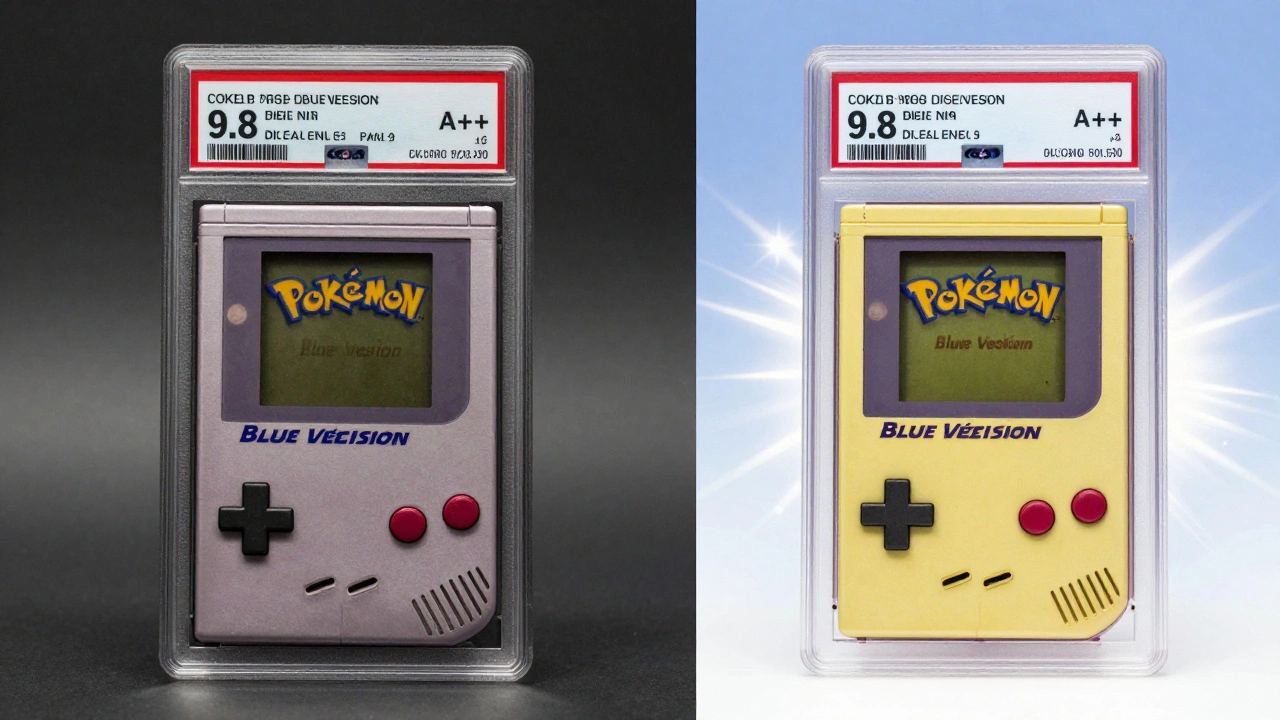
While Zelda shows pure grade appreciation, Pokémon Blue Version for Game Boy demonstrates how rarity compounds with grade. In May 2025, a sealed first-production copy of Pokémon Blue-identifiable by a misprint on the back labeling it "Red Version"-graded CGC 9.8 A++ sold for $106,250. This was the highest price ever realized for a CGC-certified Pokémon game at Heritage Auctions.
Why did this specific game hit that number? Because it combined the highest possible grade (9.8 A++) with a unique manufacturing error. Compare this to Pokémon Sapphire or Pokémon Ruby. Even at 9.8 A+, these games typically hover in the $6,000-$6,300 range. The difference between $6,000 and $106,000 isn’t just about the grade; it’s about the underlying asset’s scarcity. The grade unlocks the value, but the rarity determines the ceiling.
This creates a dangerous trap for new collectors. Grading a common game to a 9.8 won’t make it valuable. You need both high demand (iconic status) and high supply constraints (first print, rare variant) for the grade cliff to work in your favor.
The Market Correction: Volatility in 2025-2026
If the story stopped at record highs, this would be a simple guide to getting rich quick. But the market is volatile. In 2026, we are seeing a bifurcation. The "blue-chip" titles-Zelda, Metroid, early Pokémon-are holding strong. However, mid-tier grades and less iconic games are crashing.
Consider the data from Metal Gear Solid. A WATA 9.8 A+ copy sold for $38,000 in 2021. By April 2026, similar high-grade copies have seen significant depreciation. More strikingly, a WATA 9.6 A++ copy of an iconic title that sold for $102,000 in 2021 dropped to $57,600 in April 2026-a 43% decline. This reflects broader concerns about grading credibility. Some collectors argue that graders are too lenient, inflating the supply of high-grade slabs. When trust wavers, prices correct.
This correction has created a "floor" for the highest grades. Copies graded 9.4 and above for historically significant titles remain stable because there are simply fewer of them. The market has decided that while there might be too many 9.0s, true 9.8s are still incredibly rare. As a result, the price jump between 9.4 and 9.8 has actually widened in relative terms, making the top tier safer but much more expensive to enter.
Strategic Decisions: To Grade or Not to Grade?
So, what should you do with your collection? If you have a loose copy of an iconic game worth $100, submitting it for grading costs roughly $100-$200. If it comes back as an 8.5, you might sell it for $300. That’s a modest profit, barely covering shipping and risk. But if it comes back as a 9.4, you’re looking at five figures. The gamble is extreme.
Here’s a practical checklist for deciding whether to submit a game:
- Is it sealed? Loose games rarely benefit enough from grading to justify the cost unless they are ultra-rare prototypes.
- Is it iconic? Focus on first-party Nintendo titles, early Sega classics, or seminal PlayStation releases. Niche RPGs rarely command the same premiums.
- Does it look perfect? Be honest. If you see a white line in the shrink wrap, a bent corner, or a label crease, it likely won’t clear 9.0. Don’t waste money on a slab that will limit your upside.
- Check the Pop Report. Look up the title on WATA or CGC population reports. If there are already 50 copies graded 9.8, the market is saturated. If there are zero, you might hold the key to the next record.
In 2026, the smartest move is often to wait. The market is stabilizing. Prices for 9.4+ grades are firm, but 8.5-9.0 grades are softening. Buy the dip on high-grade slabs, but avoid paying peak prices for mid-tier grades. The gap between 8.5 and 9.8 remains the largest wealth generator in collectibles, but only if you start with the right asset.
What is the biggest price jump in graded video games?
The most dramatic jumps occur between the 9.4 and 9.8 grades. For example, a standard ungraded copy of The Legend of Zelda (NES) is worth ~$120, while a WATA 9.8 A++ copy of a similar iconic title has sold for $1.56 million. This represents a 13,000% increase. The jump from 8.5 to 9.0 is also significant, often tripling or quadrupling value.
Is it worth grading a video game in 2026?
It depends on the grade and the title. High-grade (9.4+) copies of iconic titles like Zelda or early Pokémon remain strong investments. However, mid-grade (8.5-9.0) copies of less popular games have seen significant price drops in 2025-2026. Only grade sealed, iconic games with near-perfect condition.
What is the difference between WATA and CGC grading?
Both WATA and CGC are industry leaders. WATA is known for slightly stricter grading standards, which can make their high-grade slabs rarer and sometimes more valuable. CGC has a larger market share and dominates high-profile auctions like Heritage Auctions. Both use a 1.0-10.0 scale for cases and A-A++ for seals.
How does seal condition affect price?
Seal condition acts as a multiplier. An A++ seal (perfect shrink) commands a 30-50% premium over an A+ seal at the same numerical grade. At the highest levels (9.8), an A++ seal is often mandatory for record-breaking prices.
Why did the graded video game market crash in 2025-2026?
The market experienced a correction due to concerns about grading consistency and oversaturation of mid-grade slabs. Collectors became skeptical of certain grades, leading to a drop in prices for 8.5-9.0 ranges. However, top-tier grades (9.4+) for iconic titles have remained resilient.