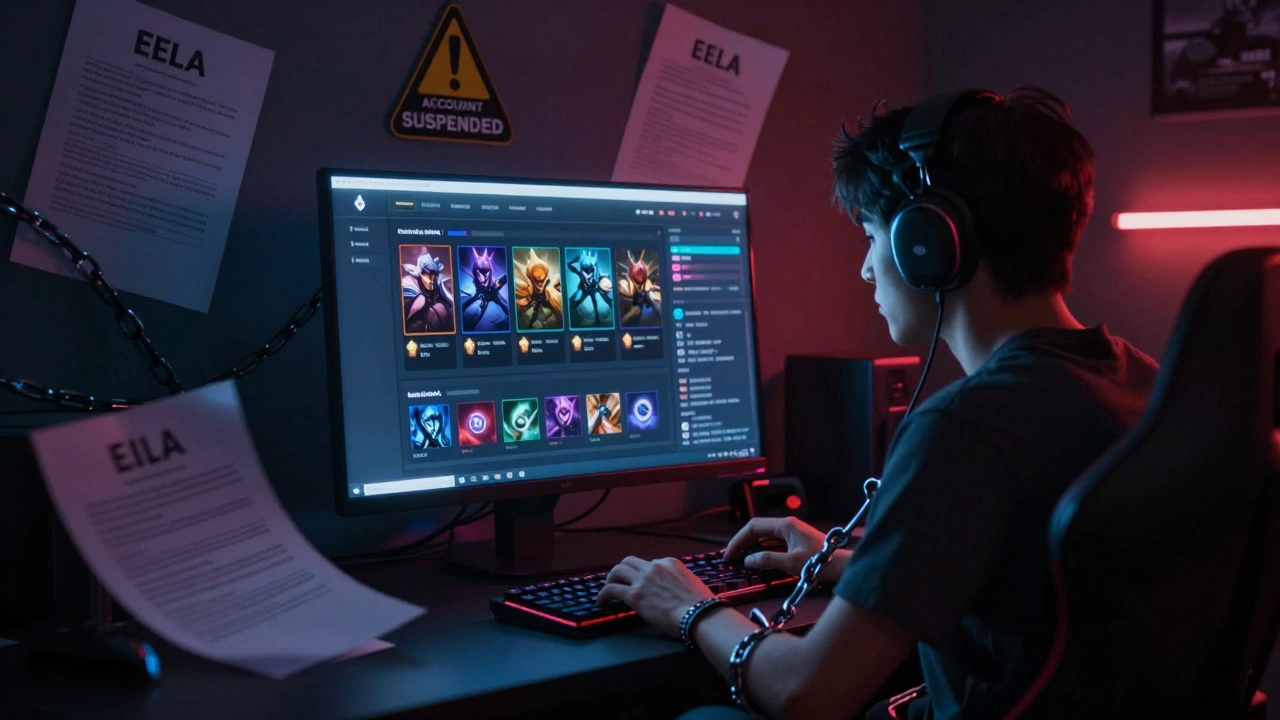
When you buy a game, you think you own it. You paid for it. You spent hours grinding, saving up for that rare skin, that legendary weapon, that account with 10 years of history. But here’s the truth: you don’t own any of it. What you bought was a license - a temporary, revocable permission to play. And that license comes with a legal contract you never read: the End-User License Agreement (EULA).
Every time you click "I Agree," you’re signing away rights most people assume are theirs. Your account, your items, your money - all subject to the developer’s rules. And those rules? They can change overnight. You can lose everything - without warning, without appeal, without compensation.
What You Think You Own vs. What the EULA Actually Says
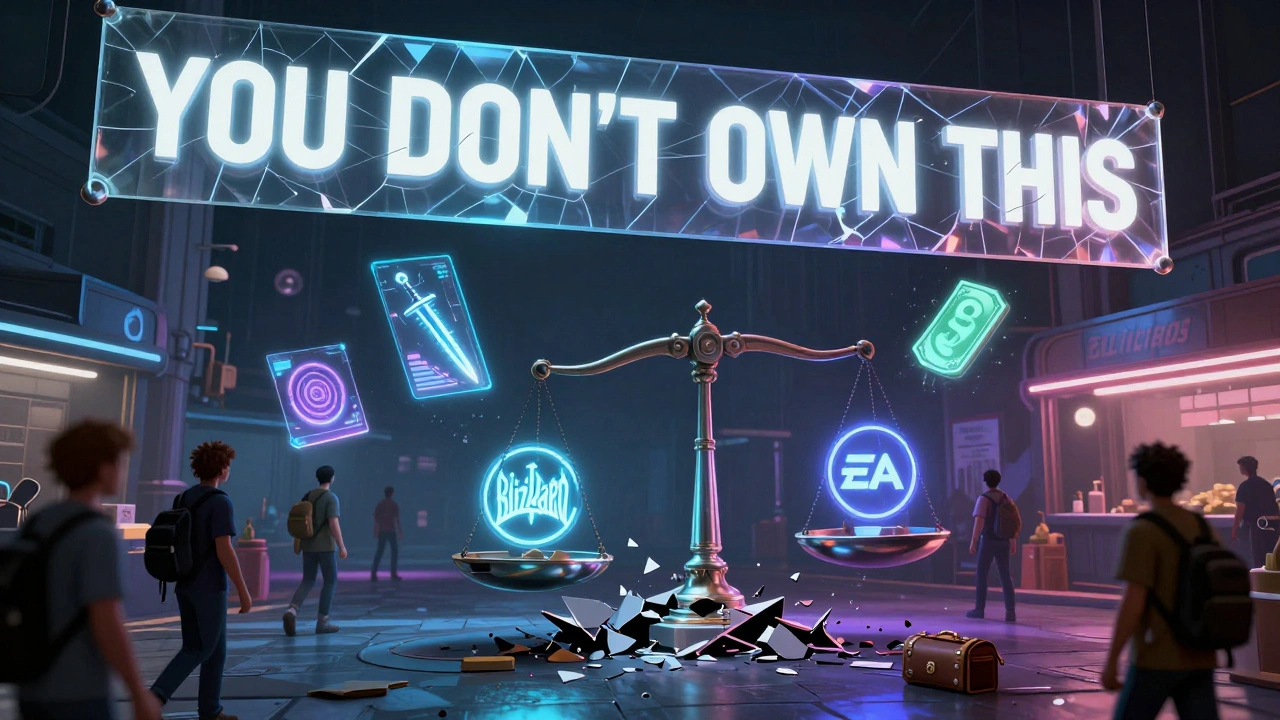
Most players believe buying a game or an in-game item means they own it. That’s not how it works. The EULA doesn’t just restrict behavior - it redefines ownership. In World of Warcraft, for example, Blizzard doesn’t sell you a character or a sword. It gives you a license to use them only as long as you follow their rules. And those rules say you can’t sell, trade, or transfer your account. Not even to a family member.
That’s not an accident. It’s by design. Developers like Blizzard, EA, and Activision treat digital items as non-transferable assets. Why? Because if players could freely trade accounts or items, it would undermine their control over the economy. They’d lose the ability to sell you more content, or to ban you for "exploiting" a glitch they never fixed.
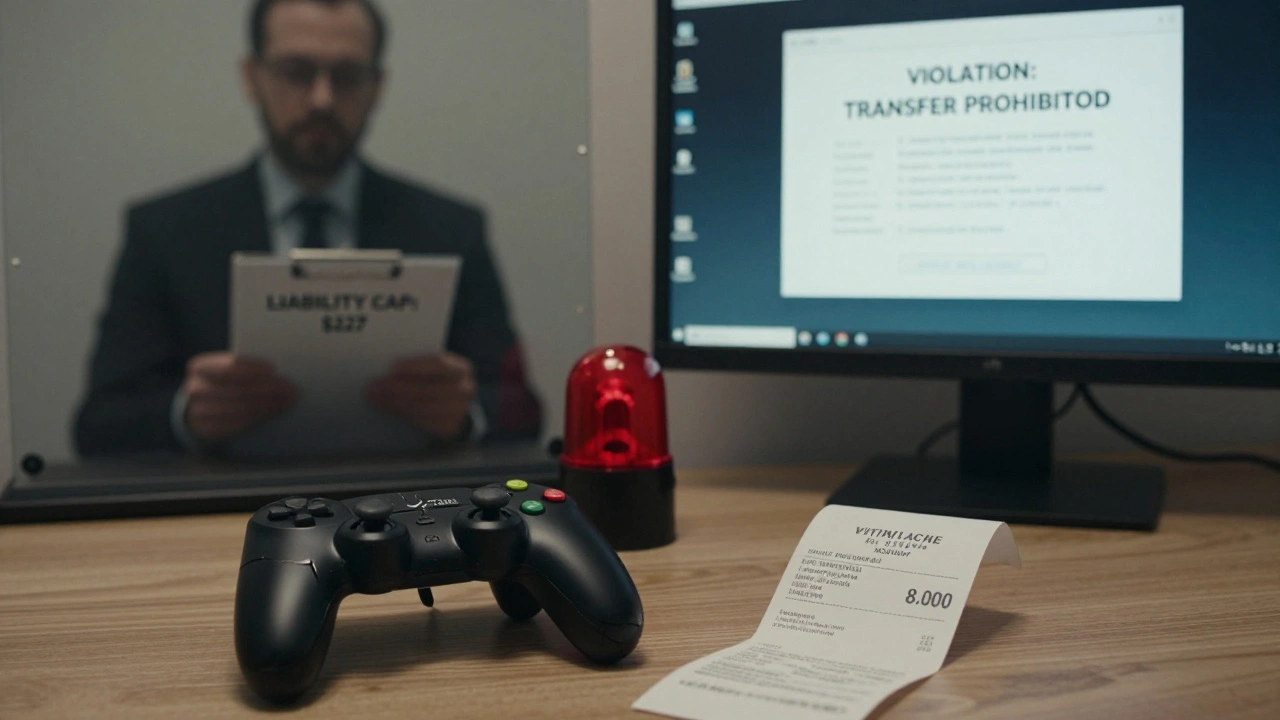
The Wisconsin Law Review found that World of Warcraft’s EULA caps player transactions at 22 times the company’s own liability. So if you lose $5,000 in-game because of a hack or scam, Blizzard’s maximum payout is $227 - the amount they’ve collected from you in the last six months. You lose everything. They lose almost nothing.
Trading Accounts? You’re Breaking the Law
Buying a leveled-up account from a stranger on eBay? Selling your account to fund rent? That’s not a gray area - it’s a direct violation of every major game’s EULA. And the consequences are real.
In 2023, a player in Germany spent over $8,000 on Eve Online assets, including rare ships and rare mining rigs. He sold the account to another player through a third-party site. Within days, CCP Games - the developer - froze the account, citing EULA violations. The buyer had no recourse. The seller lost his money. And CCP? They didn’t have to refund a cent.
Why? Because the EULA says: "You may not transfer your account or any in-game items to another player." That’s it. No exceptions. Even if the trade was fair, even if both parties agreed, even if the developer made money from the transaction (because they took a cut from the third-party site). The EULA overrides everything.
And it gets worse. Developers don’t just ban you for trading - they ban you for using a glitch. In World of Warcraft, if you find a bug that lets you duplicate gold, and you use it once - even if you didn’t mean to - you can get permanently banned. No appeal. No refund. All your progress, your time, your money - gone.
When the Game Becomes a Scam - And the Developer Walks Away
Some players don’t just trade items. They build entire economies inside games. In Eve Online, a player created a virtual bank that offered 10% monthly returns on in-game currency. Hundreds of players deposited millions of ISK (the game’s currency) - equivalent to over $100,000 in real money.
The "bank" collapsed. The creator vanished. Players lost everything. They contacted CCP, demanding justice. But CCP refused to act. Why? Because the EULA didn’t explicitly say "you can’t run a Ponzi scheme." So technically, the scammer didn’t break the rules. The system allowed it. The developer wasn’t liable.
This isn’t rare. It’s systemic. When a game allows player-driven economies, developers often turn a blind eye - until things go wrong. Then they point to the EULA and say: "You agreed to this. It’s not our problem."
And that’s the real danger. You’re not just risking your money. You’re risking your trust in a system that has no accountability.
Are Game Developers Regulated as Banks?
Here’s the twist: if a game lets you buy virtual currency with real money and then trade it to someone else - who then cashes it out - you’re not just playing a game. You’re using a financial system.
The Financial Crimes Enforcement Network (FinCEN) says this is money transmission. And in the U.S., anyone who moves money between people - even in virtual currency - needs a license. Forty-nine states require it. New York, California, and Louisiana have specific rules for virtual currency.
So why aren’t more game companies licensed? Because they claim they’re not intermediaries. They say: "We sell you coins. You use them in-game. We don’t handle trades between players."
But that’s not true. Games like Rocket League and Counter-Strike 2 have built-in marketplaces where players trade skins. Developers take a cut. They track every transaction. They control who can sell and when.
That’s money transmission. And if regulators ever crack down, these companies could be fined millions - or shut down. But until then? They profit from it. And you? You’re the one who loses everything if the system collapses.
Your Data Isn’t Safe - Even If You Never Trade
Even if you never sell your account or buy a skin, your data is still at risk. Most EULAs give developers permission to collect everything: your IP address, your device ID, your browsing habits, your payment history, even your microphone and camera access if you use voice chat.
In 2018, Take-Two Interactive (publisher of Grand Theft Auto and NBA 2K) was caught collecting personal data from minors without parental consent. The data included location, device usage, and social media activity. It wasn’t just for ads. It was for behavioral profiling.
Under the GDPR (Europe’s strict privacy law), this would be illegal. But EULAs often say: "We may collect, store, and share your data as necessary for our services." Courts have upheld these clauses - even when they violate basic privacy rights.
So if you’re worried about hackers stealing your account? That’s the least of your problems. The company already has your credit card, your real name, your home address - and they’re legally allowed to keep it forever.
Why EULAs Won’t Change - And What That Means for You
Some people suggest creating global escrow systems to protect players’ assets. Others want laws that recognize digital ownership. But here’s the reality: developers have no incentive to change.
Why? Because EULAs give them total control. They can ban you for using a glitch. They can change prices overnight. They can shut down servers and refund nothing. They can collect your data. They can sell your skin to someone else. And they can do it all without liability.
Even courts side with them. In Norway and Germany, judges ruled that a digital download is "delivered" the moment it starts - even if the player never finishes installing it. That means you can be charged for a game you never played. And you can’t get your money back.
The system is rigged. Players are the ones with skin in the game. Developers are the ones with all the rules.
What Can You Do?
You can’t change the EULA. You can’t force developers to recognize ownership. But you can protect yourself.
- Never buy accounts from third-party sellers. You’re not getting a product - you’re buying a time bomb.
- Use separate payment methods for gaming. Don’t link your main credit card to your Steam, Epic, or Battle.net account.
- Track every purchase. Keep receipts, screenshots, and transaction logs. You’ll need them if you get banned.
- Don’t assume your progress is safe. Back up your data. Export your inventory. Save your stats. You might need them later.
- Understand that your "investment" is not protected. Treat in-game spending like gambling - not like buying a car or a house.
The truth is simple: in video games, you’re not a customer. You’re a user. And users don’t own anything. They just get to play - until the next update.
Can I legally sell my video game account?
No. Every major game’s EULA explicitly prohibits the sale or transfer of accounts. Even if you’re the original owner, selling your account violates the contract you agreed to. Developers can and do ban accounts involved in these transactions - and they’re not required to refund any money.
If I lose my account, can I sue the game company?
It’s nearly impossible. Most EULAs force you into mandatory arbitration, which means you can’t go to court. Even if you could, the company’s liability is capped - often to just a few months of subscription fees. Courts consistently side with developers, citing your agreement to the EULA as binding.
Do EULAs violate consumer protection laws?
Legally, consumer rights should override EULAs. But in practice, developers design EULAs to be unchallengeable - with arbitration clauses, choice-of-law provisions (like Delaware), and fine print that makes lawsuits too expensive for individuals. So while you have rights on paper, you rarely have the power to enforce them.
Are blockchain games different? Do they give me real ownership?
Blockchain games claim to give you true ownership, but most still operate under traditional EULAs. Even if your NFT is on the blockchain, the game’s rules can still ban you, freeze your assets, or shut down the server. Until regulators force developers to separate ownership from access, blockchain doesn’t change the power imbalance.
What happens if a game shuts down permanently?
You lose everything. No refunds. No transfers. No exceptions. Developers are not legally required to preserve your data or compensate you. Games like Star Wars: Galaxies and City of Heroes shut down with no warning - and players lost millions in real money.
There’s no easy fix. The system is built to protect companies - not players. The only way to stay safe is to play with your eyes open. Assume every purchase is temporary. Assume every account can vanish. And assume that the company you trusted will never be held accountable.