Ever bought a video game bundle and felt like you just scored a genius deal-even though you didn’t need half the stuff? That wasn’t luck. It was engineered. Behind every "limited-time offer," slashed price tag, and "premium" upgrade in your favorite game is a carefully crafted system designed to make you feel smart while spending more. This isn’t magic. It’s price anchoring-and it’s everywhere in gaming.
How Your Brain Gets Trickied by Prices
Your brain doesn’t calculate value like a calculator. It uses shortcuts. One of the oldest and most powerful is called price anchoring. When you first see a price, your brain locks onto it as a reference point. Everything else gets judged relative to that number. Think about it: You’re browsing a game store and see a bundle for $49.99. Then you spot another one for $79.99 with extra skins, a battle pass, and 2000 coins. At first glance, $79.99 feels steep. But then you notice a third option: $59.99, with almost everything from the $79.99 bundle, minus two cosmetic items. Suddenly, $59.99 feels like a steal. You didn’t need the extra skins. But now, you’re buying the middle option because it feels "just right." That’s not an accident. It’s called the Goldilocks effect. Developers don’t randomly pick three price points. They design them to steer you toward the one that makes them the most money. The expensive option? It’s not meant to sell. It’s there to make the mid-tier look smart. The cheap option? It’s a decoy-so unappealing that you avoid it without even thinking.The Decoy That Tricks You Into Spending More
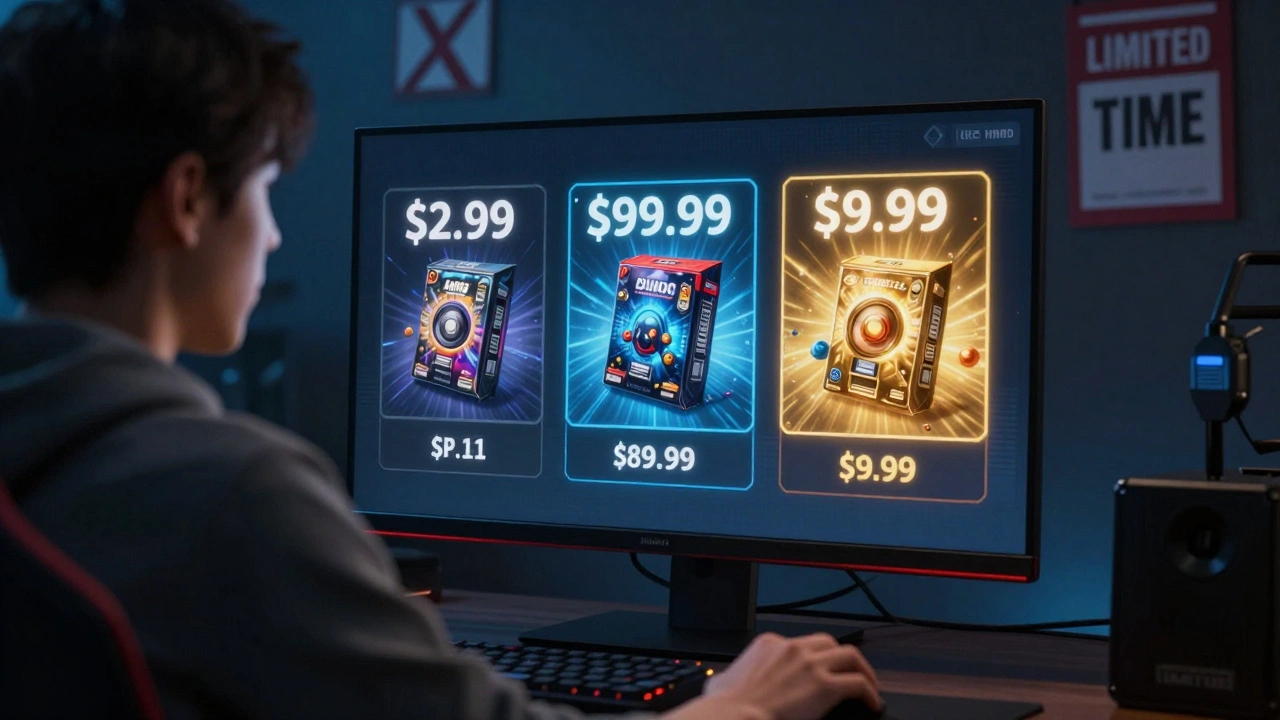
Take mobile games like Clash Royale or Farmville 2. When you open the shop, you’re usually shown only three options-even though there are ten more hidden behind taps. Why? To avoid choice paralysis. Too many options freeze you. Three? That’s manageable. And guess what? Two of those three are designed to look bad on purpose. One is too small: 100 coins for $2.99. The other is too big: 10,000 coins for $99.99. The sweet spot? 2,500 coins for $9.99. It’s not the best value mathematically. But it feels like the smart choice. You’re not comparing coins per dollar. You’re comparing how much more you get than the cheap option-and how much less you’re spending than the "crazy expensive" one. This works because of a psychological quirk called the asymmetrically dominated choice. When you add a clearly worse option, people start favoring the one that beats it in most ways. The decoy doesn’t sell. It makes the target option look better by contrast.Why $19.99 Feels So Much Cheaper Than $20
You’ve seen it everywhere: $19.99, $29.99, $49.95. Why not just round it? Because your brain doesn’t process numbers the way math does. This is called charm pricing. Studies show people mentally chop off the last digits. $19.99 becomes "nineteen," not "twenty." Your brain thinks it’s closer to $10 than $20. That’s why a game priced at $19.99 sells 20-30% more than one priced at $20-even though the difference is one cent. In gaming, this trick is everywhere. A battle pass might be $9.99. A deluxe version? $19.99. A "premium" bundle? $29.99. Each one feels like a bargain because the last digit is 9. The psychology is so strong, even seasoned gamers fall for it. You know it’s manipulation. You still buy it.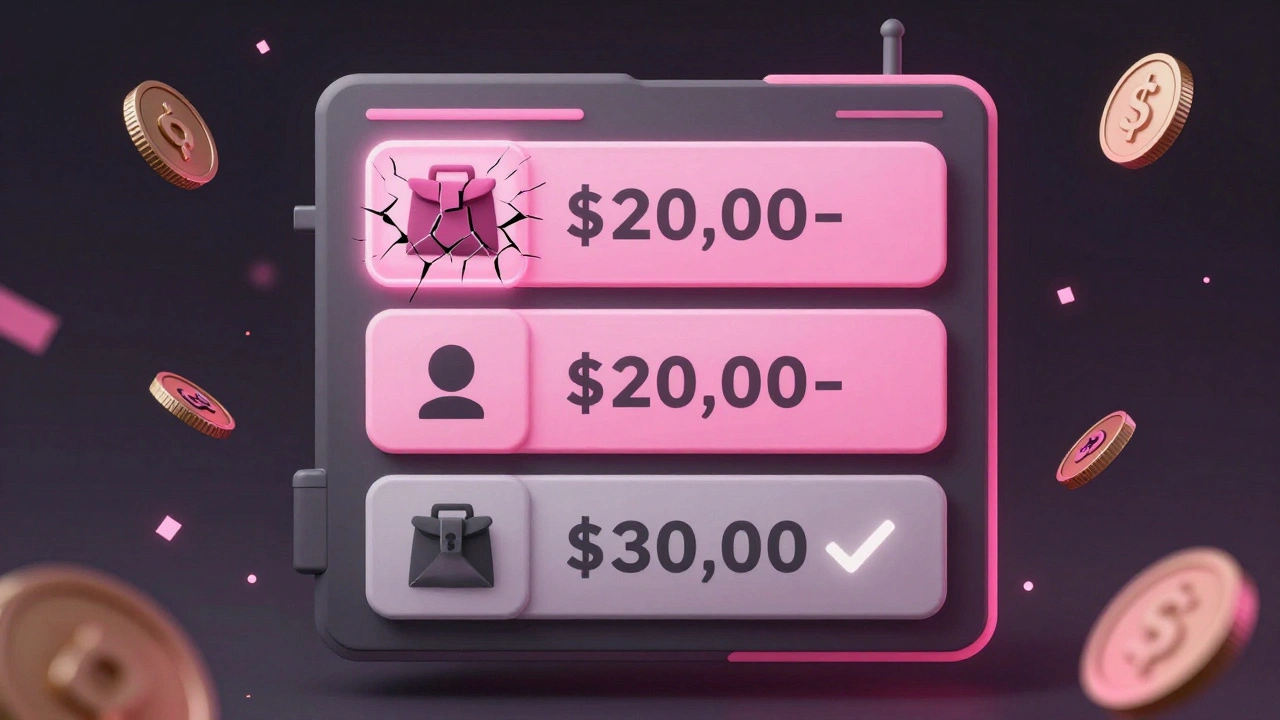
The Negotiation You Never Had
Here’s the weirdest part: you think you’re negotiating. Even though prices are fixed, game stores create the illusion of bargaining. You see "Was $79.99, Now $49.99!" with a red line through the old price. Or you get two side-by-side options: "Standard Edition" and "Deluxe Edition with Bonus Skins." The moment you see both, your brain starts comparing. It feels like you’re choosing between deals. You’re not. Both prices were set in advance. This taps into something deep: humans evolved to haggle. For thousands of years, buying meant negotiation. Even today, in a digital store with no human to talk to, we still want to feel like we got a deal. The slashed price, the bonus items, the "only 3 left!" timer-they all trigger that ancient urge to bargain. And here’s the kicker: you feel proud of yourself for "getting" the deal. That’s the endowment effect in action. You don’t just buy the game-you feel like you earned it. That’s why people brag about buying a game on sale for $15 when it was $60 at launch.Why Nobody Wants to Pay Full Price
Most gamers won’t buy a new game at full price unless it’s a highly anticipated title like Starfield or Final Fantasy XVI. For everything else? Wait. Wait for the sale. Wait for the bundle. Wait for the weekend discount. Why? Because of social perception. Paying full price makes you look like you didn’t do your homework. In gaming communities, people joke about "full-price noobs." It’s not just about saving money-it’s about proving you’re savvy. You don’t want to be the one who paid $70 when everyone else got it for $35. Industry data backs this up. Over 80% of games drop in price within two months. The average discount? Around 40%. Experienced players know this. They track release dates, set alerts, and wait. It’s not irrational. It’s learned behavior.How Bundles Make You Feel Smarter
Bundles are the ultimate psychological weapon. A game for $59.99? Meh. A game + 10 skins + 500 coins + a battle pass for $69.99? That’s a steal. The math doesn’t always add up. But you don’t do the math. You see "everything you want" in one package. The skins? You didn’t need them. The coins? You’ll probably waste them. But bundled together? They feel valuable. You’re not buying a game. You’re buying a "complete experience." Developers know this. That’s why they slap "BONUS CONTENT" labels on everything. Even if the bonus is just a digital poster or a nameplate, it makes the price feel justified. You’re not paying more. You’re getting more.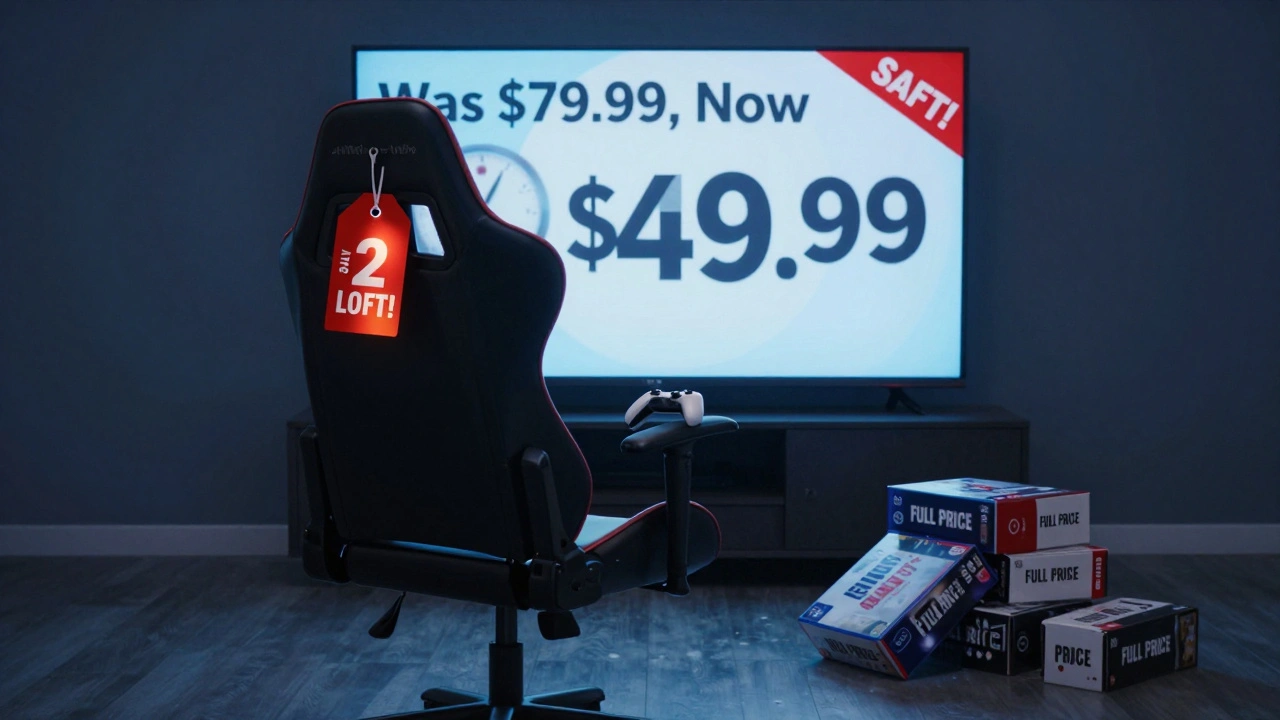
What You Can Do About It
You’re not helpless. Awareness is your best weapon.- Always ask: "What’s the real value?" Don’t compare prices-compare what you actually get.
- Ignore the "was" price. It’s fake. Check historical prices on sites like IsThereAnyDeal or SteamDB.
- Wait 60-90 days after launch. Most games hit their lowest price then.
- If you’re tempted by a "limited-time" offer, wait 24 hours. If you still want it, you probably do.
- Don’t fall for the decoy. If the cheapest option is obviously bad, it’s there to make the middle one look good.
It’s Not Just About Money
Price anchoring isn’t about tricking you into spending. It’s about making you feel like you’re winning. Game companies aren’t evil. They’re using psychology that’s been proven for over a century. The same tactics work in restaurants, car dealerships, and SaaS subscriptions. What’s different in gaming is how seamlessly it’s woven into the experience. The best-designed stores don’t feel like stores. They feel like rewards. You don’t think, "I’m being manipulated." You think, "I found a great deal." And that’s exactly how they want you to feel. Next time you click "Buy Now," pause. Ask yourself: Is this a deal-or just a well-crafted illusion?Why do games always have three price tiers?
Three tiers are designed to exploit the "Goldilocks effect." The highest tier acts as an anchor to make the middle one seem reasonable. The lowest tier is a decoy-so unattractive that it pushes people toward the middle option, which is usually the one the company wants to sell most. It’s not random; it’s a tested strategy used in marketing for decades.
Does charm pricing really work on experienced gamers?
Yes. Even gamers who know about charm pricing still fall for it. The brain processes $19.99 as "nineteen," not "twenty." That mental shortcut happens automatically. It’s not about ignorance-it’s about how our brains are wired. Studies show people still perceive $19.99 as significantly cheaper than $20, even when they’re told the difference is just a penny.
Why do games have "Was $79.99, Now $49.99" labels if the original price was never real?
Those "original" prices are often set artificially high to create a sense of savings. Even if the game was never sold at that price, the visual contrast makes the current price feel like a discount. This taps into the psychological principle of contrast bias-when something looks better next to something worse. It’s not deception in a legal sense, but it’s designed to trigger emotional reactions, not rational ones.
Is it smarter to buy games on sale or wait for bundles?
Bundles often offer better value, especially if you’re interested in cosmetics or extra content. A game on sale for $30 might be cheaper than a bundle at $40-but if the bundle includes skins, a battle pass, and coins you’d buy anyway, the bundle gives you more overall value. Check historical prices and compare what’s included. Sometimes, waiting for a bundle is smarter than just waiting for a sale.
Do price anchors work differently on mobile games vs. PC/console?
The core psychology is the same, but mobile games rely more heavily on decoys and charm pricing because purchases are smaller and more frequent. On PC/console, the anchor is often the full price of the game itself. On mobile, it’s the cost of a single currency pack. Mobile interfaces show fewer options to prevent overload, making each choice more impactful. The principles are identical, but the execution is tuned to the platform’s spending habits.