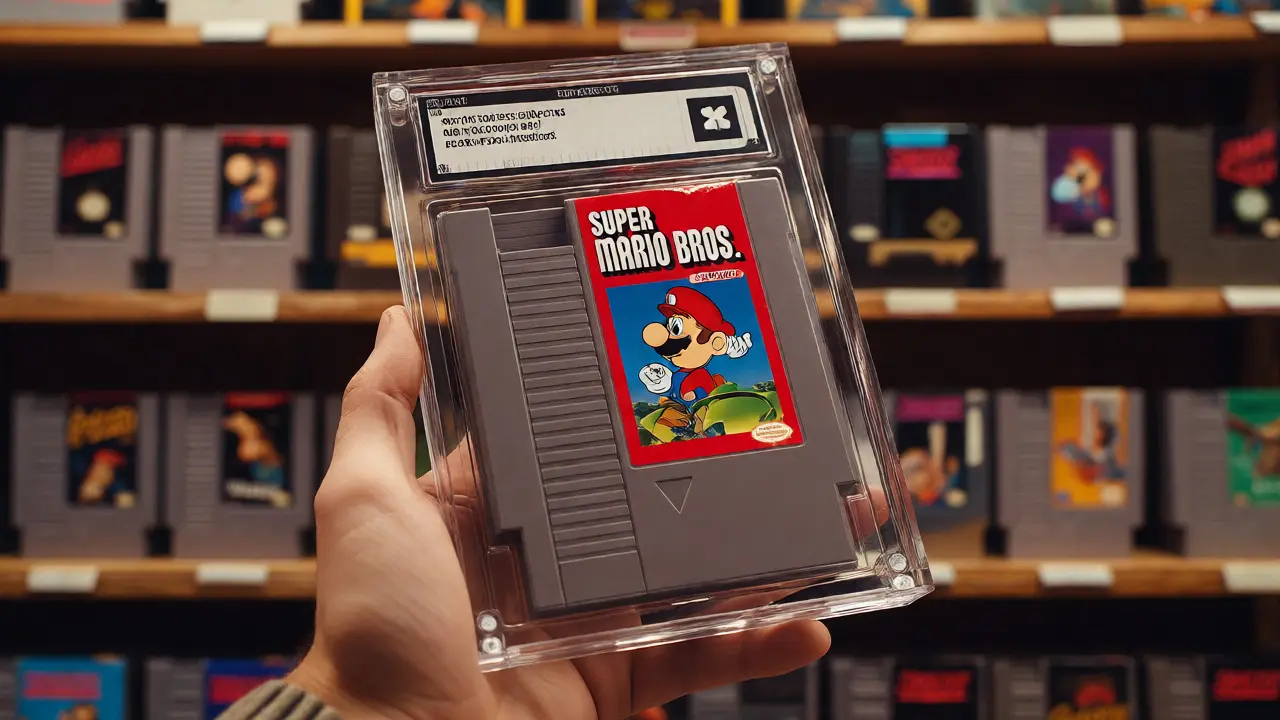
You just spent three hours cleaning a dusty cartridge of Super Mario Bros. and sending it off to be graded. You get back a slab with a 9.8 rating. Your heart skips a beat. Is this the jackpot? Or did you just pay $50 in grading fees for something worth the same amount at a garage sale? The grade tells you condition, but it doesn't tell you scarcity. That’s where population reports come in. If you don’t know how to read them, you’re flying blind in the secondary market.
Population reports are the census data of the collectibles world. They track exactly how many copies of a specific game have been submitted for grading and what scores they received. For video games, this data is newer and less standardized than trading cards or coins, but it’s becoming the single most important metric for determining value. A 9.6 rated copy of a common game might be worthless if there are 5,000 others out there. But that same 9.6 on a rare title with only ten known copies? That’s five figures.
Why Population Data Matters More Than Grade
Think about supply and demand. It’s basic economics, but people forget it when they see a high score. In the video game collecting hobby, we often confuse "rare" with "hard to find in good shape." These are different things. A game can be mass-produced (high supply) but rarely survives in mint condition (low supply of high grades). Population reports show you the latter. When you look at a report, you aren't just seeing numbers; you're seeing the competitive landscape. If you want to sell, you need to know how many other sellers are competing against you. If you want to buy, you need to know if you’re overpaying for a grade that’s actually abundant. Ignoring this data is like buying a house without checking how many other houses are for sale in the neighborhood.
The Major Players: WATA vs. VGA vs. Others
Not all population reports are created equal. The video game grading industry is still young, so the databases aren't as unified as they are for Pokémon cards or sports memorabilia. Currently, two names dominate the conversation: WATA Games and VGA (Video Game Authority).
WATA Games uses a proprietary system called VGR (Video Game Rating). Their database is widely considered the most comprehensive for sealed and loose games. When collectors talk about "pop reports," they usually mean WATA's public search tool. It breaks down submissions by console, region, and edition. This granularity is crucial because a US release of Zelda II has a completely different population profile than a Japanese release, even if the game code is similar.
VGA focuses heavily on authenticity and condition, using a strict grading scale. Their population data is accessible through their website, though it’s sometimes less detailed regarding regional variations compared to WATA. Other services like CGC (Certified Guaranty Company) have entered the space recently. CGC brings the massive infrastructure they built with comics and cards. As of 2026, CGC’s video game population data is growing rapidly, and savvy investors are watching how their numbers compare to WATA’s legacy data.
| Service | Primary Database Strength | Data Granularity | Best For |
|---|---|---|---|
| WATA Games | Historical depth & Regional splits | High (Region/Edition) | Retro consoles & Rare titles |
| VGA | Authenticity verification | Medium | Strict condition checks |
| CGC Games | Volume & Modern speed | Increasingly High | High-volume modern titles |
Decoding the Report: What Each Column Means
When you pull up a report, you’ll see columns like "Total Submissions," "Grades," and "Top Pop." Let’s break down what these actually tell you.
- Total Submissions: This is the total number of times this specific game (by UPC or internal ID) has been sent to the grader. Note: This does not mean this many copies exist in the wild. It means this many were deemed worthy of paying $40-$100 to grade. Many cheap games never make it into the report because owners don’t bother grading them.
- Grade Distribution: This shows how many copies got a 9.0, 9.2, 9.4, etc. This is your rarity curve. If a game has 500 submissions but only two scored a 9.8, that 9.8 is extremely rare. If 200 scored a 9.8, it’s common.
- Top Pop: Short for "Top Population." This indicates the highest grade achieved so far and how many copies hold that grade. If the Top Pop is 9.8 with a count of 3, those three slabs are the best known examples in existence according to that service.
- Rank: Some platforms rank games by total submissions. A low rank means few people have graded it, which could indicate obscurity or extreme rarity. Be careful here-sometimes low rank just means nobody cares about the game.

Navigating Regional and Edition Variations
This is where beginners get burned. A population report for "Final Fantasy VII" is useless if you don’t specify the region. The US NTSC release, the European PAL release, and the Japanese original all have distinct populations. Furthermore, within the US alone, you might have the first print run versus later reprints. WATA allows you to filter by these details, but you have to know what you’re looking for. For example, a 1990s Sega Genesis game might have thousands of graded copies in the US. But if you check the "First Print" variant, the population might drop to under fifty. Always verify the exact version identifier. If you buy a game based on a generic population report, you might end up owning a common reprint while thinking you bought a rare first press.
Using Data to Spot Value Traps
Here’s a scenario: You see a listing for a graded Pokémon Red at a 9.6 for $2,000. You check the WATA pop report. There are 150 copies graded 9.6. That seems reasonable. But then you notice the trend line. Over the last six months, 20 new 9.6s were submitted. Suddenly, that $2,000 price tag looks shaky. Supply is increasing faster than demand.
Conversely, imagine a niche RPG from the PS2 era. Only 12 copies have ever been graded. One is a 9.8. The seller asks $500. Even if the game isn't famous, the absolute scarcity creates a floor price. You won’t find another one easily. Population reports help you distinguish between "expensive because popular" and "expensive because scarce." Both can be good investments, but they behave differently during market downturns. Scarce items tend to hold value better; popular items crash harder when hype dies.

Limitations of Current Population Data
Don’t treat these reports as gospel truth. They suffer from survivorship bias. People only submit games they think are valuable or in great condition. Nobody sends a scratched-up copy of Tetris to WATA. Therefore, the report doesn’t reflect the true total population of the game worldwide-it only reflects the "graded market" population. Also, errors happen. Misidentified editions can skew numbers. If a user submits a European copy as a US copy, and the grader misses it, the US population count inflates artificially. Always cross-reference with physical attributes like spine art, box inserts, and disc codes. And remember, private sales don’t always update the public database immediately. There is often a lag time between a submission and its appearance in the public search.
Practical Steps for Buyers and Sellers
If you’re buying, start by searching the exact title and console. Filter by your target grade. Look at the "Top Pop" count. If you’re targeting a 9.6, and there are 500 of them, negotiate hard. If there are five, pay up quickly. Check the date of the last submission. A spike in recent submissions suggests more supply is coming, which should lower prices.
If you’re selling, use the report to justify your price. Attach a screenshot of the population report showing how rare your grade is. If you have the only 9.8, say so. If you’re mid-pack, acknowledge the competition. Transparency builds trust. Collectors appreciate knowing exactly what they’re getting relative to the rest of the market.
Does a higher population report number mean a game is worth less?
Generally, yes, for the same grade. Higher supply usually leads to lower prices due to increased competition among sellers. However, if demand is extremely high (like for iconic Nintendo titles), prices can remain strong despite large populations. Always look at the ratio of supply to recent sales volume, not just the raw number.
Are WATA and VGA population reports interchangeable?
No. They are separate databases. A game might have 100 graded copies at WATA and 50 at VGA. You cannot combine these numbers directly because grading standards differ slightly. A 9.6 at WATA is not guaranteed to be a 9.6 at VGA. Treat each company's data as its own ecosystem.
What does "Top Pop" mean in a video game report?
"Top Pop" refers to the highest grade awarded to that specific game edition and the number of copies holding that grade. For example, "Top Pop: 9.8 (2)" means only two copies have ever received a 9.8 from that grader. These are typically the most valuable examples.
Do ungraded copies count in population reports?
No. Population reports only include copies that have been physically submitted to the grading company and authenticated. Millions of copies may exist in attics and thrift stores, but if they haven't been graded, they don't appear in the official database.
How often are population reports updated?
Most major services like WATA and CGC update their online databases daily or weekly. However, there can be a delay of a few days between when a game is graded and when it appears in the public search results. Always check the timestamp on the report page.