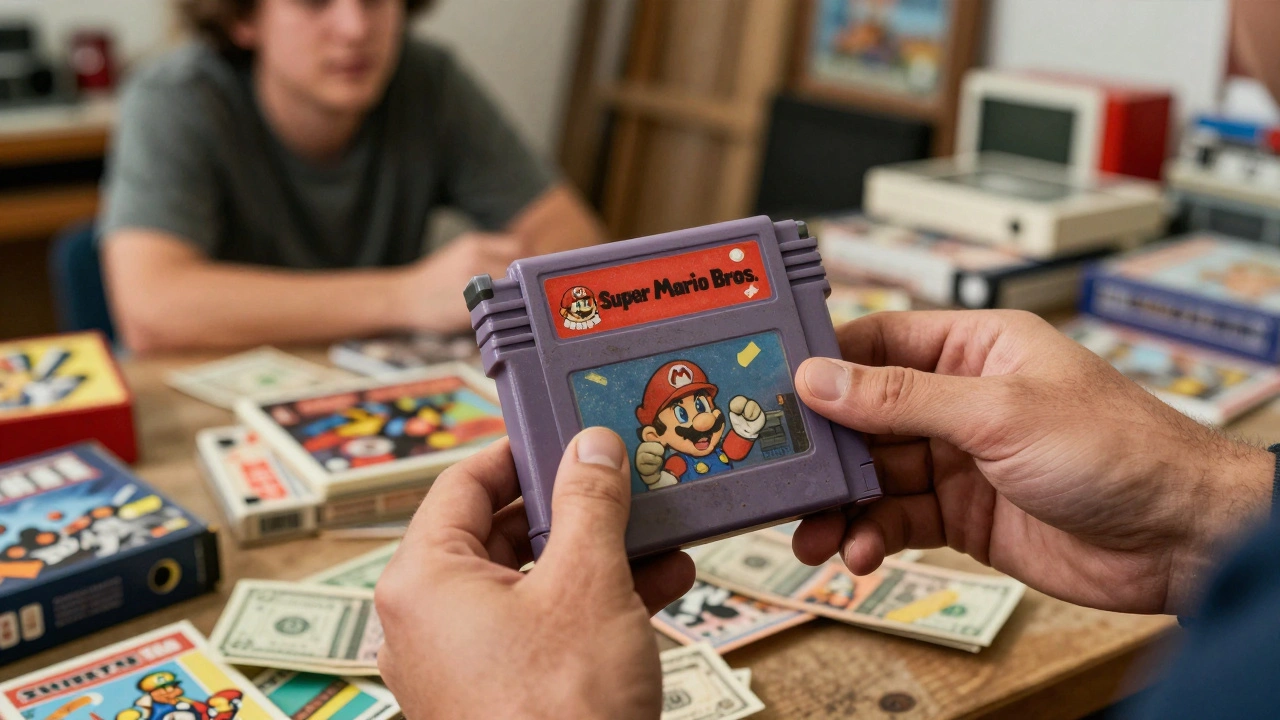
You walk into a local game store or meet someone at a garage sale. They hold out a dusty cartridge of Super Mario Bros. is a classic Nintendo Entertainment System platformer that defined the genre. The seller asks for $50. You know it’s not worth that much, but you don’t have proof. Or worse, you agree to pay it because you’re afraid of missing out. This is the exact moment where knowledge becomes currency. In the world of retro gaming, guessing your way through a negotiation is how people lose money every single day.
The market for physical video games has exploded in recent years. It is no longer just about nostalgia; it is a multi-billion dollar industry driven by finite supply and growing demand. According to research from the Federal Reserve Bank of Kansas City, the video game sector has evolved dramatically, with digital distribution and new revenue models reshaping the landscape. For collectors, this means prices are volatile. A game worth $20 three years ago might be $60 today, or it might have crashed to $10. To buy smart, you need hard data, not gut feelings.
The Foundation: Understanding Condition and Completeness
Before you look up a single price, you must understand what you are actually looking at. Value in video games is almost entirely determined by condition and completeness. A loose cartridge is worth significantly less than one that comes in its original box. That boxed copy is worth even less if it lacks the instruction manual. And a sealed copy? That can be worth ten times the price of a loose one.
You need to categorize the item immediately. Is it loose? That means just the cartridge or disc, no box, no manual. Is it Complete-in-Box (CIB)? This includes the case, the game media, and usually the manual. Is it sealed? Never opened, plastic wrap intact. Finally, is it graded? This refers to copies that have been professionally inspected and encapsulated by services like WATA or VGA. These grades, often ranging from 1 to 10, add a layer of premium value because they guarantee authenticity and condition. If you are negotiating for a loose cartridge, do not let the seller quote you a price for a CIB copy. Know the difference before you start talking numbers.
Step 1: Check PriceCharting for Market Trends
Your first stop should always be PriceCharting is a comprehensive online database that tracks video game prices across various platforms and conditions.. This site acts as the central hub for collectors worldwide. It aggregates sales data from major marketplaces like eBay, Amazon, and others to provide an average selling price. But more importantly, it shows you trends.
When you search for a title on PriceCharting, you will see separate values for loose, CIB, and sealed copies. Look at the chart. Is the line going up? Down? Or is it flat? If a game’s price has been steadily dropping over the last six months, you have leverage. You can tell the seller, "I see this game peaked last year and has dropped 15% since then." If the price is spiking upward, maybe due to a new remaster announcement or viral social media attention, you might want to move faster or accept a higher price. PriceCharting gives you the big picture context that individual listings cannot provide.
Step 2: Verify with eBay Sold Listings
While PriceCharting gives you averages, eBay is a global online marketplace known for its auction format and vast inventory of collectibles. sold listings give you the reality. Active listings show what sellers *want*. Sold listings show what buyers *actually paid*. There is a massive difference between the two.
Here is the exact workflow you should use:
- Go to eBay and type in the game title. Keep it simple. For example, search "Ogre Battle 64" instead of the full long title.
- Click on the "Filters" button.
- Under "Condition," select the specific state of the item you are buying (e.g., "Pre-Owned" for loose, or check "Used" for CIB).
- Crucially, under "Item Location," choose "All Items" or filter by region if shipping costs matter.
- Look for the option that says "Sold Items" or "Completed Items." On the mobile app, this is often a toggle switch. On desktop, it is a checkbox near the top right.
Now you are seeing real transactions. Ignore the ones that say "Unsold." Those are irrelevant. Focus on the last 5 to 10 sales that match your item’s condition exactly. If you are buying a loose cartridge with a slightly worn label, do not average in sales for pristine cartridges. Match the description closely.
Add up those five prices and divide by five. That number is your baseline. If the average is $40, and the seller wants $60, you have your opening argument. "I checked the last five sales on eBay, and they all went for around $40. I can offer $35 cash right now." Specificity wins negotiations.
Step 3: Consult Auction Archives for Rare Items
If you are dealing with a high-value item-think rare Nintendo 64 titles, early PlayStation prototypes, or graded copies-the eBay average might still be too low. Serious collectors often turn to auction houses like Heritage Auctions is a leading auction house specializing in collectibles including vintage video games and memorabilia.. These archives record hammer prices for items that rarely appear on standard retail sites.
For common games, Heritage data isn't necessary. But for a sealed copy of E.T. the Extra-Terrestrial or a graded Pokemon Red, these auctions set the ceiling. If a similar graded copy sold for $15,000 at Heritage last month, that establishes a market benchmark. However, be careful. Auction prices can be inflated by bidding wars among wealthy collectors. Use these figures to understand the upper limit of value, but do not expect to pay that amount in a casual transaction unless the item is truly unique.

Avoiding Common Valuation Pitfalls
New collectors make mistakes that cost them money. Here is what to avoid:
- Relying on List Prices: Just because a local store lists a game for $30 doesn’t mean it sells for $30. Stores mark up prices to cover overhead. Always check sold data.
- Mixing Conditions: Do not compare a loose cartridge price to a CIB price. They are different products.
- Ignoring Region Codes: A PAL version of a game (European) might be worth less than the NTSC-U version (North American) depending on the title. Make sure the sold listings you review are for the same region code.
- Using Outdated Data: Prices change. A guide from 2020 is useless in 2026. Always check sales from the last 30 to 90 days.
| Tool | Best Used For | Limitations |
|---|---|---|
| PriceCharting | Quick averages and trend analysis | May lag on sudden spikes; algorithmic averages can hide outliers |
| eBay Sold Listings | Real-time actual sale prices | Requires manual filtering; small sample sizes for rare items |
| Heritage Auctions | High-end, graded, or ultra-rare items | Prices may be inflated by collector bidding wars |
| Local Game Stores | Immediate availability | Prices include markup; not reflective of true market value |
Negotiation Strategy: Presenting Your Case
Research is only half the battle. How you present it matters. When you are ready to negotiate, have your phone open with the data visible. Do not say, "I think this is worth less." Say, "Based on the last five comparable sales on eBay, the market value is $40. I am offering $35."
This shifts the conversation from subjective opinion to objective fact. Most sellers are not experts; they are just people clearing out attics. They respect data. If they refuse to lower the price despite clear evidence, walk away. There will always be another game. The goal is to build a collection you love without overspending on every item.
Remember, the time investment is small. Checking PriceCharting takes two minutes. Scanning eBay sold listings takes five. Doing this research protects your wallet and turns you into a savvy collector. In a market where values shift daily, being informed is your best advantage.
Is PriceCharting accurate for current values?
PriceCharting provides a good baseline average based on historical sales data from multiple platforms. However, it can sometimes lag behind sudden market spikes or crashes. For the most precise current value, always cross-reference PriceCharting with recent eBay sold listings to ensure the data reflects the last few weeks of activity.
Why are eBay sold listings better than active listings?
Active listings show what sellers hope to get, which is often inflated. Sold listings show the actual price a buyer agreed to pay. This removes wishful thinking from the equation and gives you a concrete number based on real transactions, making it the most reliable metric for negotiation.
Does grading increase a game's value significantly?
Yes, for certain titles. Professionally graded copies from services like WATA or VGA can command premiums of 2x to 10x the ungraded price, especially for sealed games or highly sought-after classics. However, grading costs money and time, so it is only worthwhile for high-demand items. For common games, the cost of grading often exceeds the added value.
How do I handle items with only one or two recent sales?
For rare items with limited sales history, treat the most recent sold price as the best available estimate. You can also look further back in time (3-6 months) to find more data points, adjusting for any known market trends. If the item is extremely valuable, consider consulting auction house archives for additional comparables.
Should I trust local game store prices?
Local game store prices are generally higher than market value because they include overhead costs like rent and staff wages. While convenient for immediate purchases, these prices are not ideal for determining fair market value during private negotiations. Always use online sold data as your primary reference.