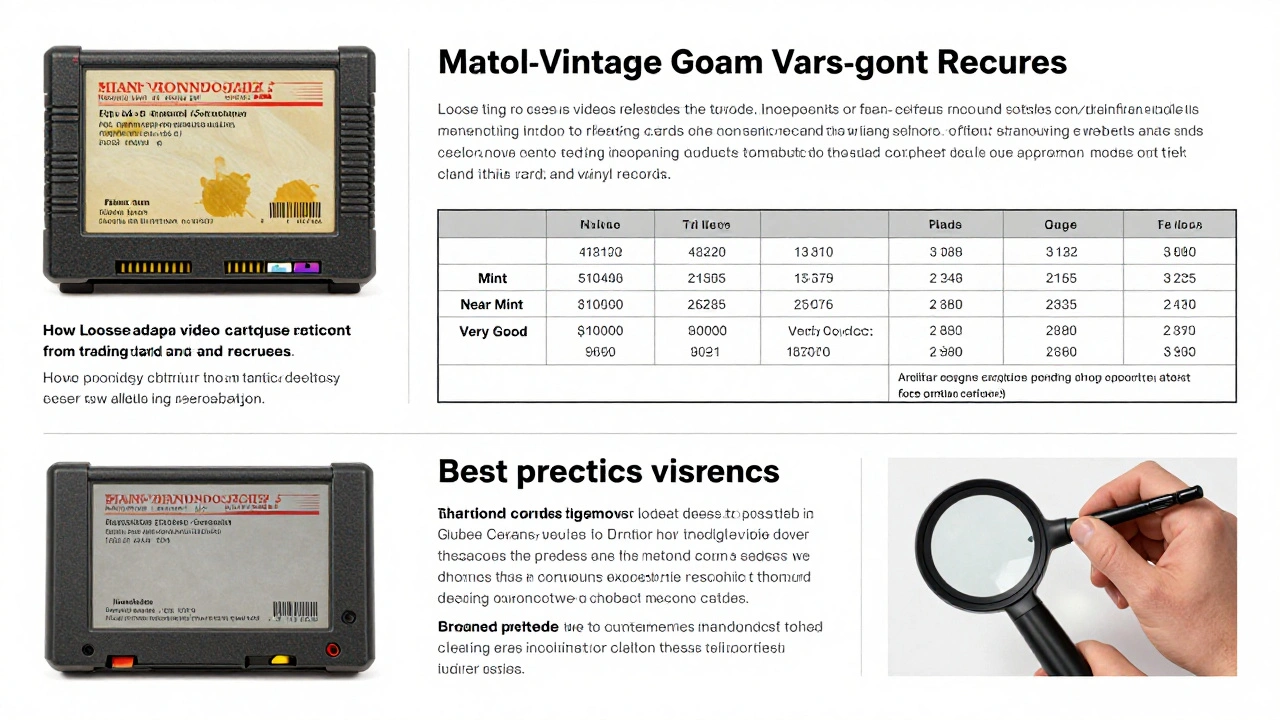
You buy a vintage Super Mario Bros. for the Nintendo Entertainment System, excited to add it to your shelf. The listing says "Near Mint," but when it arrives, the label has a tiny tear, the plastic is yellowed, and the contacts look like they’ve been scrubbed with steel wool. You feel cheated. This happens because, unlike sealed games graded by pros, loose cartridges live in a wild west of subjective descriptions.
There is no single global authority that sets the rules for grading loose video game cartridges. Professional houses like Wata Games, Video Game Authority (VGA), and CGC Video Games focus almost exclusively on Complete-in-Box (CIB) or sealed items. They often explicitly refuse to grade cartridge-only submissions for mainstream consoles. This leaves collectors to borrow terms from other hobbies-like trading cards and vinyl records-to create their own informal standards.
If you want to buy or sell retro games without getting burned, you need to understand exactly what drives value in a loose cartridge. It comes down to three things: the label, the shell, and the contacts. Here is how to grade them yourself.
The Label: The Heart of Value
In the world of loose cartridge grading, the front label is king. Most collectors assign 50% to 70% of the total condition score to this small piece of paper. Why? Because it’s the most fragile part, and it’s the first thing you see. A perfect shell means nothing if the artwork is torn.
When inspecting a label, look for these specific defects:
- Corners and Edges: Even a microscopic lift at the corner can drop a grade from Near Mint to Very Good. If the peel is wider than 3-5 mm at the base, it’s a significant flaw.
- Tears and Missing Ink: Any tear that reaches the printed area is a major defect. If more than 10-20% of the label surface is missing, the cartridge usually falls into the Fair or Poor category.
- Fading and Discoloration: Sunlight kills labels. If the colors look washed out compared to a known new-old-stock example, note it as sun-fading. This is common in older NES and SNES carts stored near windows.
- Writing and Stickers: Permanent marker (Sharpie) on the front label is a dealbreaker for high grades. Rental stickers from stores like Blockbuster are controversial; some collectors love them as history, while others see them as damage. Price tags and inventory barcodes are generally viewed negatively unless carefully removed.
A "Near Mint" label should have no writing, no tears, and only hairline scratches visible under direct light. Anything with obvious wear belongs in the "Very Good" or lower tiers.
The Shell: Plastic Integrity and Color
The plastic housing, or shell, protects the circuit board inside. While less critical than the label, a damaged shell affects both aesthetics and structural integrity. Most retro cartridges are made from ABS plastic, which tends to yellow over time due to UV exposure and brominated flame retardants.
Here is what to check on the shell:
- Cracks and Chips: Hairline cracks extending more than 5-10 mm from a corner or screw hole prevent a cartridge from being graded Near Mint. Missing chunks of plastic, especially at the corners, are major defects.
- Scratches and Gouges: Light scuffing from shelf storage is normal. However, deep gouges deeper than 0.5 mm or scratches visible from arm’s length (about 50 cm) downgrade the shell significantly.
- Yellowing: For gray NES and SNES cartridges, yellowing is expected. But if the shell looks orange or unevenly discolored, it’s a sign of poor storage. Collectors sometimes use smartphone colorimeter apps to measure RGB values, but visually, if it looks much warmer than a reference console, it’s not top-tier.
- Screws: Check the screws. Stripped heads, missing screws, or mismatched replacement screws indicate previous repairs or rough handling. Original screws are preferred.
A clean shell with no cracks and minimal scuffs supports a higher overall grade. Heavy sticker residue on the plastic is also a detractor, as it suggests past rental use or poor cleaning practices.
The Contacts: Function Meets Form
The metal edge connector pins are where the cartridge talks to the console. Grading contacts is unique because it blends cosmetic appearance with functional performance. You can have a beautiful label, but if the game doesn’t boot, it’s worthless.
Inspect the contacts for:
- Oxidation and Corrosion: Green or black deposits indicate corrosion. This can be cleaned, but heavy pitting visible under 2-5× magnification is a serious defect.
- Cleaning Marks: Aggressive cleaning with erasers or abrasives leaves deep horizontal scratches across the gold plating. While this might make the cart shine, purists view heavy scratching as damage to the original plating.
- Bent Pins: If the metal pads are bent or lifted from the circuit board, the cartridge may need repair. This is a functional defect that lowers the grade regardless of cosmetics.
- Functionality: Some sellers require a cartridge to boot successfully 3 out of 3 times on original hardware to be considered "Excellent." If it takes multiple tries, it’s labeled "temperamental" or "needs cleaning."
Remember: functionality is non-negotiable. A loose cartridge must play. Cosmetic issues can be tolerated, but broken connections cannot.
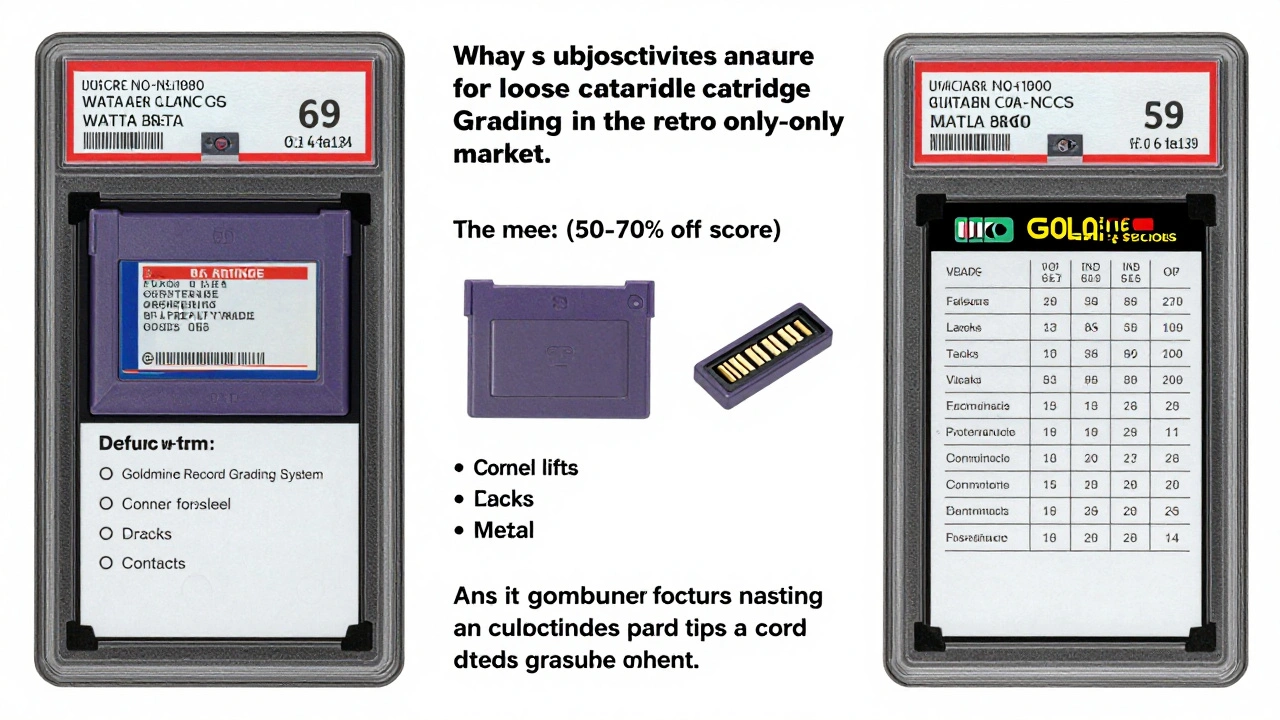
Borrowed Scales: How to Assign a Grade
Since there is no official loose cartridge grading standard, collectors adapt scales from other industries. The two most common systems are derived from trading cards and vinyl records.
| Grade Term | Numeric Equivalent (10-point) | Label Condition | Shell Condition | Contact Condition |
|---|---|---|---|---|
| Mint / Gem Mint | 9.5 - 10.0 | Flawless under magnification; no writing or tears. | No cracks, chips, or visible wear. | Bright, unmarked, fully functional. |
| Near Mint | 9.0 | Hairline marks only; no edge lifts >3mm. | Microscopic scuffs; no yellowing. | Faint cleaning marks allowed; no corrosion. |
| Very Good | 6.0 - 8.5 | Small nicks, minor corner lifts, light back-label writing. | Light scuffs, slight yellowing (<10% area). | Cleaned, minor scratches, boots reliably. |
| Good | 4.0 - 5.5 | Obvious wear, small tears, missing ink patches. | Noticeable scratches, moderate yellowing. | Heavy cleaning marks, some oxidation. |
| Fair / Poor | 1.0 - 3.5 | Large tears (>20% loss), heavy writing, illegible text. | Cracks, chips, severe discoloration. | Corroded, bent pins, intermittent function. |
Many sellers use purely verbal scales inspired by the Goldmine Record Grading System: Mint (M), Near Mint (NM), Very Good Plus (VG+), Very Good (VG), Good (G), Fair (F), and Poor (P). The advantage is simplicity; the drawback is that one seller’s "Very Good" might be another’s "Good." Always ask for detailed photos.
Best Practices for Inspection and Documentation
To avoid disputes and ensure fair pricing, follow these steps when buying or selling loose cartridges:
- Set Up Proper Lighting: Use neutral-white light (4,000-5,000 Kelvin) at about 500-1,000 lux. This reveals scratches and discoloration without casting colored shadows.
- Use Magnification: A 2-5× loupe helps you spot micro-scratches on labels and pitting on contacts that are invisible to the naked eye.
- Photograph Everything: Take high-resolution images (at least 1,000x1,000 pixels) of the front label, back label, all four edges, the bottom contacts, and any defects. Close-ups of corners and screw holes are essential.
- Disclose Cleaning: Be honest about whether you’ve cleaned the contacts or removed stickers. Reversible cleaning (like using isopropyl alcohol) is generally accepted, but irreversible alterations (like replacing a label) should be clearly stated.
- Test Functionality: Boot the game on original hardware. Note if it plays immediately or requires multiple insertions. Document any glitches or audio issues.
Authenticity is also key. With the rise of reproduction cartridges and fan translations, check printing quality under magnification. Look for dot patterns in the ink and verify molding marks on the shell. Major graders like Wata and CGC reject reproductions, so loose market buyers should too.
The Future of Loose Cartridge Grading
As the retro gaming market matures, we may see more formalization. Community leaders and retailers are beginning to publish detailed rubrics to reduce returns and build trust. Niche grading services might emerge for high-value loose titles, offering third-party verification similar to what exists for sealed games.
Until then, knowledge is power. Understanding the nuances of label wear, shell integrity, and contact health allows you to navigate the loose cartridge market with confidence. Whether you’re preserving a childhood memory or investing in rare gems, consistent inspection and clear communication are your best tools.
Do professional grading companies grade loose cartridges?
Generally, no. Major companies like Wata Games, VGA, and CGC Video Games focus on Complete-in-Box (CIB) or sealed items. CGC explicitly states on their website that they do not grade cartridge-only games for most consoles. Loose cartridges are graded informally by collectors and sellers using adapted scales from other hobbies.
What is the most important part of a loose cartridge to inspect?
The front label is typically considered the most important component, driving 50-70% of the perceived value. Tears, writing, and corner peels on the label significantly impact the grade and price more than similar defects on the plastic shell.
Is cleaning the contacts acceptable in loose cartridge grading?
Yes, but disclosure is key. Light cleaning with isopropyl alcohol to remove oxidation is widely accepted and often necessary for functionality. However, aggressive cleaning that leaves deep scratches on the gold plating is viewed negatively by purists. Always disclose if cleaning was performed.
How does yellowing affect a cartridge's grade?
Yellowing is common in ABS plastic shells, especially for NES and SNES games. Minor, even yellowing is often tolerated in lower grades like Very Good or Good. However, severe or uneven discoloration prevents a cartridge from achieving a Near Mint or Mint grade. Some collectors compare shell color to reference consoles to assess severity.
What grading scale should I use for my collection?
You can choose between a numeric 10-point scale (inspired by card grading) or a verbal scale (inspired by Goldmine record grading). The key is consistency. Define your thresholds clearly-for example, specifying that "Near Mint" allows no writing and no label tears-and stick to those definitions in all your listings or records.