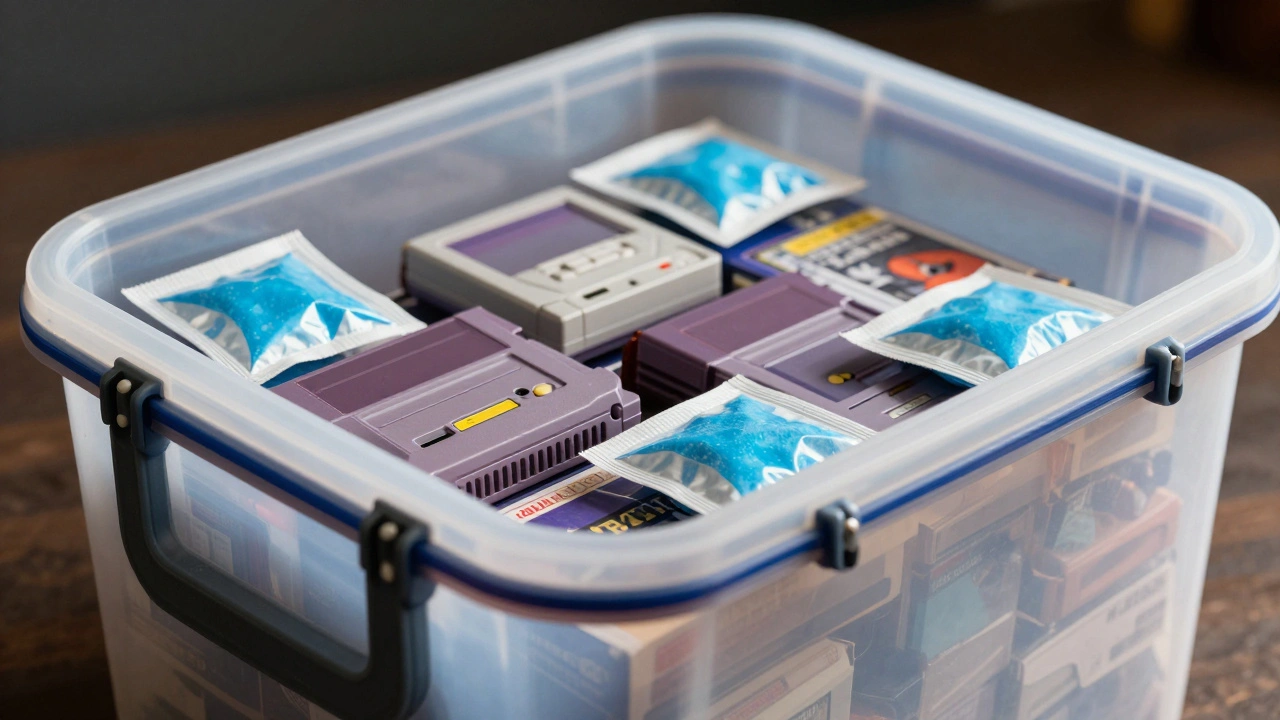
Storing your retro game cartridges, consoles, or boxed collectibles isn’t just about keeping them out of the way. It’s about stopping slow, invisible damage before it ruins decades of nostalgia. Moisture is the silent killer here-not water you can see, but humidity in the air that creeps into plastic, corrodes metal pins, and turns cardboard yellow. And the best defense isn’t a climate-controlled room or a fancy safe. It’s something you’ve probably seen in shoeboxes or electronics packaging: silica gel.
What Silica Gel Really Does
Silica gel isn’t magic. It’s just silicon dioxide, the same stuff found in sand, but shaped into millions of tiny, porous beads. These pores grab water molecules from the air and hold them tight. A single gram can absorb up to 40% of its own weight in moisture. That’s why a packet the size of a thumbprint can protect a whole shoebox of games. Unlike sponges that soak up water and drip, silica gel traps moisture inside its structure. It doesn’t leak. It doesn’t spill. And if it’s dry, it won’t add any moisture back.Most packets you buy are clear beads. But some have color indicators-blue when dry, pink when full. Those are handy. They tell you when it’s time to recharge them. Don’t ignore the color change. A saturated packet doesn’t help. It can even make things worse.
How Much Do You Need?
You don’t need a bucket of silica gel. Too much is just wasted. Too little, and it gets overwhelmed fast. The rule is simple: 50 to 100 grams per cubic foot of storage space.Let’s break that down. A standard plastic storage bin that’s 18 x 14 x 10 inches holds about 1.5 cubic feet. That means you need 75 to 150 grams of silica gel. Most retail packets are 1 gram or 3 grams. So you’d need 25 to 50 of those. Sounds like a lot? It’s not. You can buy bulk silica gel in 100-gram bags for under $10. That’s enough for five bins.
If you live in a humid place-like Portland, Oregon, where humidity often hits 70% in summer-double the amount. Go with 100 to 200 grams per cubic foot. Don’t guess. Measure your container. A tape measure and a calculator take 30 seconds. Your games will thank you.
The Container Matters More Than the Gel
Here’s the biggest mistake people make: putting silica gel in a plastic bin with a flimsy snap-lid. Those lids don’t seal. Air moves in and out. The gel soaks up moisture, then the next humid day floods the bin again. It’s like trying to bail out a boat with a teaspoon while the hull’s full of holes.You need an airtight container. Look for ones with compression latches-like ammo cans, heavy-duty plastic storage boxes with rubber gaskets, or sealed metal tins. The seal should press evenly around the entire lid. Test it: close it, then try to pull the lid open. If it resists, you’ve got a good seal. If it pops open easily? Go back to the store.
Don’t use cardboard boxes. Even if they’re stacked neatly, they breathe. Moisture gets in. Mold grows. You’ll end up with sticky cartridges and crumbling manuals. Stick to rigid plastic or metal.
Where to Place the Packets
Don’t just toss a packet into the corner. Distribution matters. Place them in the four corners of the container. If you’re stacking games or manuals, slip a packet between each layer. That way, moisture gets pulled evenly from all sides.Avoid direct contact with metal parts. If a silica gel packet is nearly full and sits right against a cartridge’s gold contacts, it can hold onto moisture and slowly transfer it-creating tiny spots of corrosion. Keep packets at least an inch away from exposed metal, connectors, or circuit boards. Use a small piece of cloth or paper between the packet and the hardware if you’re worried.
For controllers, consoles, or peripherals, tuck packets into empty spaces-between the joystick and housing, under the battery compartment lid, or inside the case of a boxed game. Don’t cram them. Let air flow around them.
Prep Your Gear Before Storing
Silica gel won’t fix dirty gear. It only stops future damage. Clean first.- Wipe down metal parts with a microfiber cloth dampened with 70% isopropyl alcohol. It evaporates fast and leaves no residue.
- Use a soft brush-like a clean toothbrush-to get dust out of controller seams, cartridge slots, and vents.
- Never store anything with fingerprints, sweat, or oils on it. Skin acids eat away at plastic and metal over time.
- Remove batteries from controllers and handhelds. Even if they’re dead, they can leak. Store them separately in a labeled plastic bag.
- If you’re storing a console with a disc drive, leave the tray open slightly to prevent rubber parts from sticking.
Can You Reuse Silica Gel? Yes-But Only Right
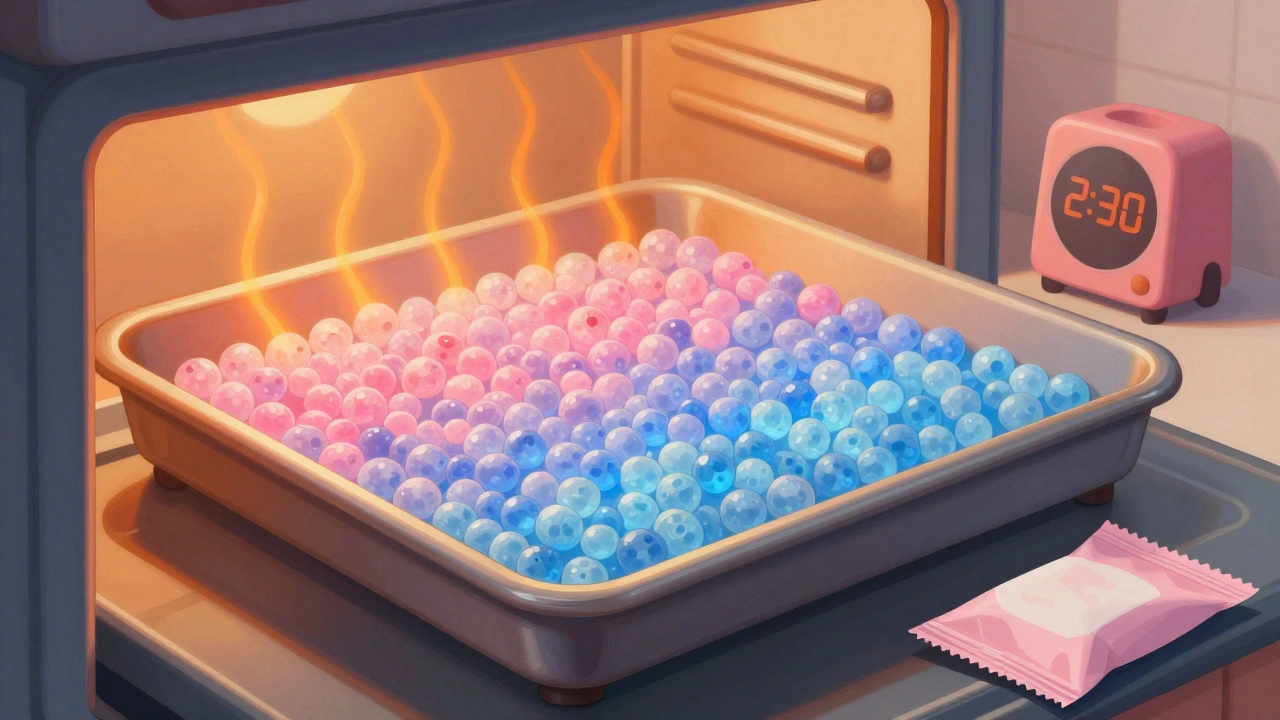
Most people throw away silica gel after it turns pink. That’s a waste. You can dry it out and use it again.Don’t use the microwave. Microwaves heat unevenly. One packet might overheat and melt, while another stays damp. You could even start a fire if the packet has a metal tag.
The best way: use an oven. Set it to 250°F (120°C). Spread the beads in a thin layer on a baking sheet. Bake for 2-3 hours. Watch the color change. Blue beads will turn back to blue. Pink ones will fade to pale. If you don’t see a change after 3 hours, leave it longer. Let it cool completely before putting it back in storage.
Check your packets every 6 months. If you’re in a dry climate, you might only need to recharge them once a year. In humid areas, every 3-4 months. Keep a log. Write the date on the container with a marker. It’s that simple.

What About Other Desiccants?
Clay-based desiccants are cheaper and often sold in bulk. They work fine, but they don’t change color. You can’t tell if they’re full. That’s risky. If you use clay, stick to silica gel with indicators. It’s worth the small price difference.Calcium chloride packets? Avoid them. They’re meant for big industrial drying, not delicate electronics. They can leak and corrode. Stick to silica gel. It’s the gold standard for gaming gear.
Storage Environment Tips
Where you store your gear matters as much as how you store it.- Avoid attics. Heat speeds up moisture absorption. A hot attic might be 110°F, but the humidity inside your bin will be worse than outside.
- Basements? Only if they’re dry. If you smell mildew, don’t store games there.
- Climate-controlled storage units? Still use silica gel. Even those can fluctuate. A little extra protection never hurts.
- Keep the room temperature steady. Between 65°F and 75°F is ideal. Fluctuations cause condensation.
And don’t forget about batteries. Store controllers and handhelds at about 50% charge. Fully charged or dead lithium batteries degrade faster. A half-charged battery lasts longer in storage.
Real-World Proof
Collectors in Japan, Germany, and the U.S. have been using silica gel for over 20 years. Cartridges from the 1980s still work because their pins never corroded. Manuals are still crisp. Box art hasn’t yellowed. It’s not luck. It’s science.The Global Gaming Peripherals Industry Whitepaper (2026) says environmental control is now a core part of collecting value. A game in perfect condition can be worth 10x more than one with a faded label or corroded connector. That’s not hype. That’s market data.
You don’t need a museum-grade vault. You just need a sealed container, the right amount of silica gel, and a habit of checking it twice a year. That’s all.
Can silica gel damage my game cartridges?
No, silica gel is chemically inert and won’t harm plastic, metal, or circuitry. The only risk is if a saturated packet leaks moisture directly onto metal contacts-but that’s rare. To prevent it, keep packets away from connectors and use a cloth barrier if needed. Proper placement eliminates any risk.
How often should I replace silica gel packets?
You don’t replace them-you recharge them. If you’re using indicating silica gel, dry it out in the oven when it turns pink. Do this every 3-6 months depending on your climate. If you’re using non-indicating gel, assume it needs drying after 6 months. Always test before reusing.
Can I use silica gel with vinyl records or comic books?
Yes. Silica gel is safe for paper, cardboard, and vinyl. Just don’t let the packets touch the surface directly. Place them in the corners of storage boxes or between layers. It prevents mold and yellowing without damaging the material.
Is it safe to store silica gel with lithium-ion batteries?
Yes. Silica gel doesn’t react with batteries. But always remove batteries from devices before long-term storage. Store them separately in a cool, dry place at 50% charge. The gel helps keep humidity low, which reduces battery degradation.
Can I use silica gel in a safe or fireproof box?
Absolutely. Fireproof safes often trap moisture inside. Adding silica gel helps prevent condensation and rust on metal parts. Just make sure the safe has a tight seal. If it’s not airtight, the gel won’t help much. Pair it with a hygrometer to monitor humidity levels.