
Ever sold a rare video game, a limited-edition controller, or a prized in-game skin for cash? You might think it’s just a side hustle - a way to turn your collection into extra cash. But the IRS doesn’t see it that way. If you’re selling video games or digital items regularly, you could be running a business - whether you realize it or not. And that changes everything when it comes to taxes.
It’s Not About How Much You Sell - It’s About Why
The biggest mistake people make is assuming that selling a few games online means they’re just a collector. That’s not how the IRS sees it. The line between hobby and business isn’t drawn by how many items you sell. It’s drawn by your intent.
If you’re selling because you enjoy hunting for rare games and occasionally cash in when you find a buyer - that’s likely a hobby. But if you’re listing items daily, tracking profits, reinvesting money into new stock, or advertising your sales on social media - you’re running a business. The IRS looks at factors like how organized you are, how much time you spend on it, and whether you expect to make a profit over time.
Here’s the catch: you don’t need to quit your day job to be a business. Even part-time sellers who make $10,000 a year from selling games can be classified as self-employed. And that changes your tax bill in ways most people don’t expect.
Business Class: More Paperwork, More Deductions
If the IRS says you’re a business, you must file Schedule C with your tax return. That means reporting every dollar you make from game sales - no exceptions. But here’s the upside: you can deduct every legitimate cost tied to that income.
- Marketplace fees (Steam, eBay, Etsy, etc.)
- Payment processing fees (PayPal, Stripe)
- Shipping supplies and postage
- Portion of your home office if you use a dedicated space
- Cost of computers or devices used primarily for listing and managing sales
- Advertising or promotional costs
These deductions can slash your taxable income. For example, if you made $15,000 selling games but spent $8,000 on fees, shipping, and equipment, you only pay taxes on $7,000 in profit.
But there’s a trade-off. Business income is subject to self-employment tax - that’s 15.3% on your net profit. It covers both Social Security and Medicare. So if you net $7,000, you owe $1,071 in self-employment tax alone. That’s in addition to federal and state income tax.
Hobby Class: No Deductions, But No Self-Employment Tax
If the IRS classifies your sales as a hobby, you still have to report the income - but you can’t deduct any costs. That’s right. Even if you paid $500 in listing fees and $300 in shipping, you still pay taxes on the full $15,000 you made.
You also don’t pay self-employment tax. That sounds good, right? But here’s the reality: without deductions, your tax bill can be higher than if you were classified as a business. Let’s say you made $15,000 in sales and spent $8,000 on costs. As a hobbyist, you pay income tax on $15,000. As a business owner, you pay income tax on $7,000 - and then pay 15.3% on that $7,000. In many cases, the business owner ends up paying less overall.
It’s counterintuitive, but true: claiming hobby status can cost you more money.
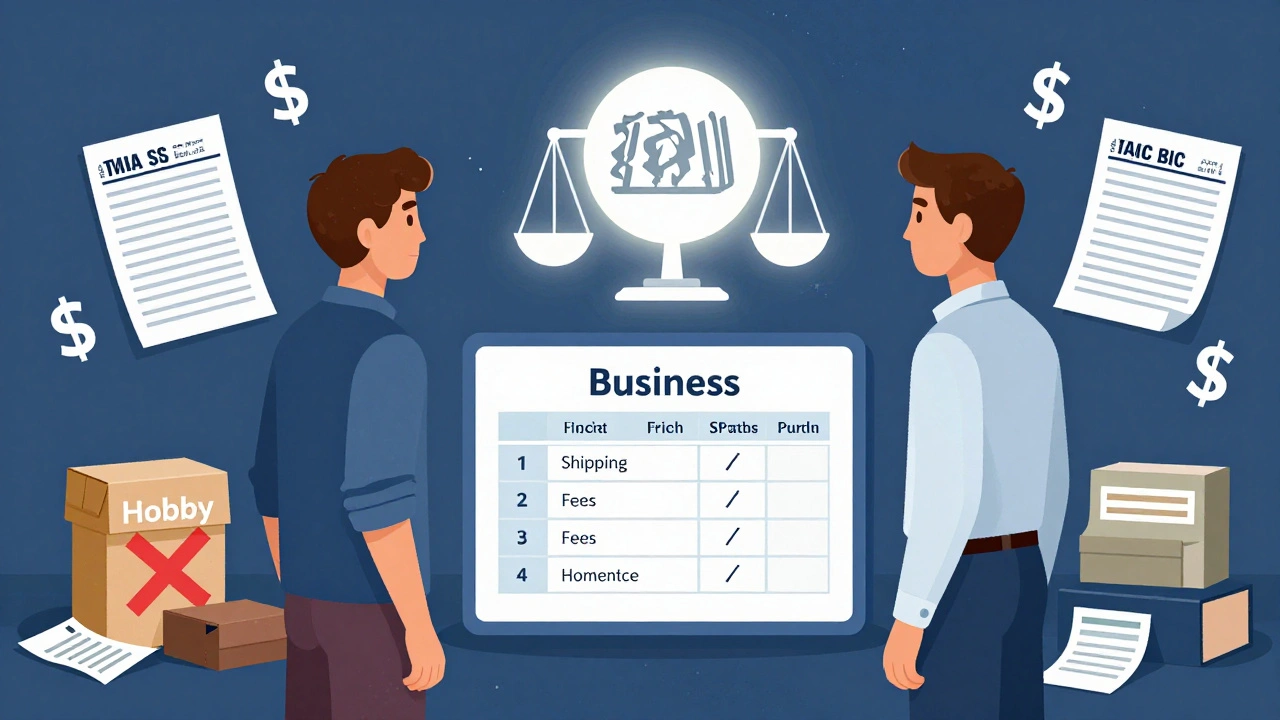
That 1099-K Form? It’s a Red Flag
If you sold over $5,000 in games through platforms like eBay, Etsy, or Steam Community Market in 2025, you probably got a 1099-K form. That’s not optional. The IRS now gets a copy too.
Getting a 1099-K doesn’t mean you’re automatically a business. But it does mean you’re on their radar. If you report that income as a hobby without deductions, the IRS may question why you’re not claiming expenses - or worse, suspect you’re hiding business activity.
And if you report it as a business but can’t prove your expenses? You’re asking for an audit. That’s why records matter.
What You Need to Prove You’re a Business
The IRS doesn’t take your word for it. If you’re audited, you’ll need documents. Here’s what they look for:
- A spreadsheet or accounting app tracking every sale: date, item, price, platform
- Receipts for all expenses: shipping labels, PayPal statements, eBay fee summaries
- Proof of time spent: screenshots of listing schedules, calendar entries, marketing posts
- Business planning notes: even a simple list like “Buy 5 games this month to resell” helps
- Separate bank account for sales income and expenses (highly recommended)
One collector I know kept handwritten logs in a notebook. When audited, the IRS accepted it - because it was consistent, dated, and detailed. You don’t need fancy software. You need proof.

Digital Goods and Sales Tax - The Hidden Trap
Here’s where it gets messier. Selling a physical game? Sales tax rules are mostly clear. But selling a digital skin, a downloadable map, or an in-game currency? That’s a different story.
States treat digital products differently. In Oregon, where I live, digital goods are not subject to sales tax. But in California? They are. In New York, a downloadable game is taxed like a physical product. A subscription to a game service? Might be taxed as a service. A virtual pet you bought in a game? Could be classified as intangible property.
If you’re selling digital items across state lines, you might be required to collect sales tax from buyers in other states - even if you’re just one person with a laptop. States now use economic nexus rules: if you make over $100,000 in sales or 200 transactions in a state, you may have to register, collect, and remit tax there.
Platforms like Steam or Discord may handle this for you - but if you’re selling directly through personal listings, you’re on the hook. Most people don’t realize this until they get a notice from a state tax agency.
What Happens If You Get It Wrong?
Claiming hobby status when you’re really a business? The IRS can go back up to three years and reassess your taxes - plus penalties and interest. That means you could owe thousands in back self-employment tax.
Claiming business status without records? You’ll lose your deductions. The IRS will disallow expenses and you’ll pay tax on the full income.
And here’s the kicker: once you claim something as a hobby, you can’t go back and change it later to claim deductions. The door shuts.
What Should You Do?
Start by asking yourself three questions:
- Do I spend more than 5 hours a week on this? (Listing, shipping, researching, marketing?)
- Do I buy items with the intent to resell for profit - not just to clear space?
- Do I track my income and expenses like a business?
If you answered yes to two or more - you’re likely a business.
Start keeping records now. Use a free app like Wave or Google Sheets. Save your receipts. Track your time. Don’t wait until tax season.
And if you’re making over $10,000 a year? Talk to a tax pro who understands digital goods. This isn’t just about games - it’s about how the law is changing for every collector turning their passion into profit.
If I sell games as a hobby, do I still have to report the income?
Yes. All income from game sales - whether hobby or business - must be reported on your tax return. The IRS gets copies of 1099-K forms from platforms, so they already know how much you made. Failing to report it can trigger an audit.
Can I switch from hobby to business status mid-year?
Yes. You can change how you report your game sales at any time, but you must be consistent going forward. If you start treating it like a business - tracking expenses, keeping records, marketing - you should file Schedule C from that point on. You can’t go back and claim deductions for prior years if you previously reported it as a hobby.
Do I need to form an LLC to be considered a business?
No. You can be a sole proprietor without an LLC, corporation, or formal business structure. The IRS cares about your behavior - not your paperwork. If you operate like a business, you’re a business, even if you never filed paperwork with your state.
Are in-game items like skins or loot boxes taxable?
Yes. If you sell them for real money, the income is taxable. Some states also require you to collect sales tax on those sales, depending on where the buyer lives. Digital items are increasingly treated as tangible property for tax purposes, especially when sold on third-party marketplaces.
What if I only sell occasionally - once or twice a year?
If it’s truly sporadic - like selling a game you no longer play after clearing out your closet - it’s likely a hobby. But if you’re doing it every few months, tracking prices, or buying to resell, the IRS may still see it as a business. Intent matters more than frequency.